An admissions chatbot answers questions when a student visits your website. An AI enrollment agent goes to the student. It contacts every new inquiry within seconds, follows up by text, voice, email and chat with one memory of the conversation, books info sessions, and warm-transfers the student to an advisor. AI dialers and voice agents sit in between. They are proactive, but they only work on the phone.
That distinction matters because "AI for admissions" now covers at least four different products, and they are sold with the same vocabulary. Most explainers compare chatbots with agents and stop there. This guide covers all four categories you're likely to see in a 2026 buying cycle, what each is good and bad at, and how to tell them apart in a demo.
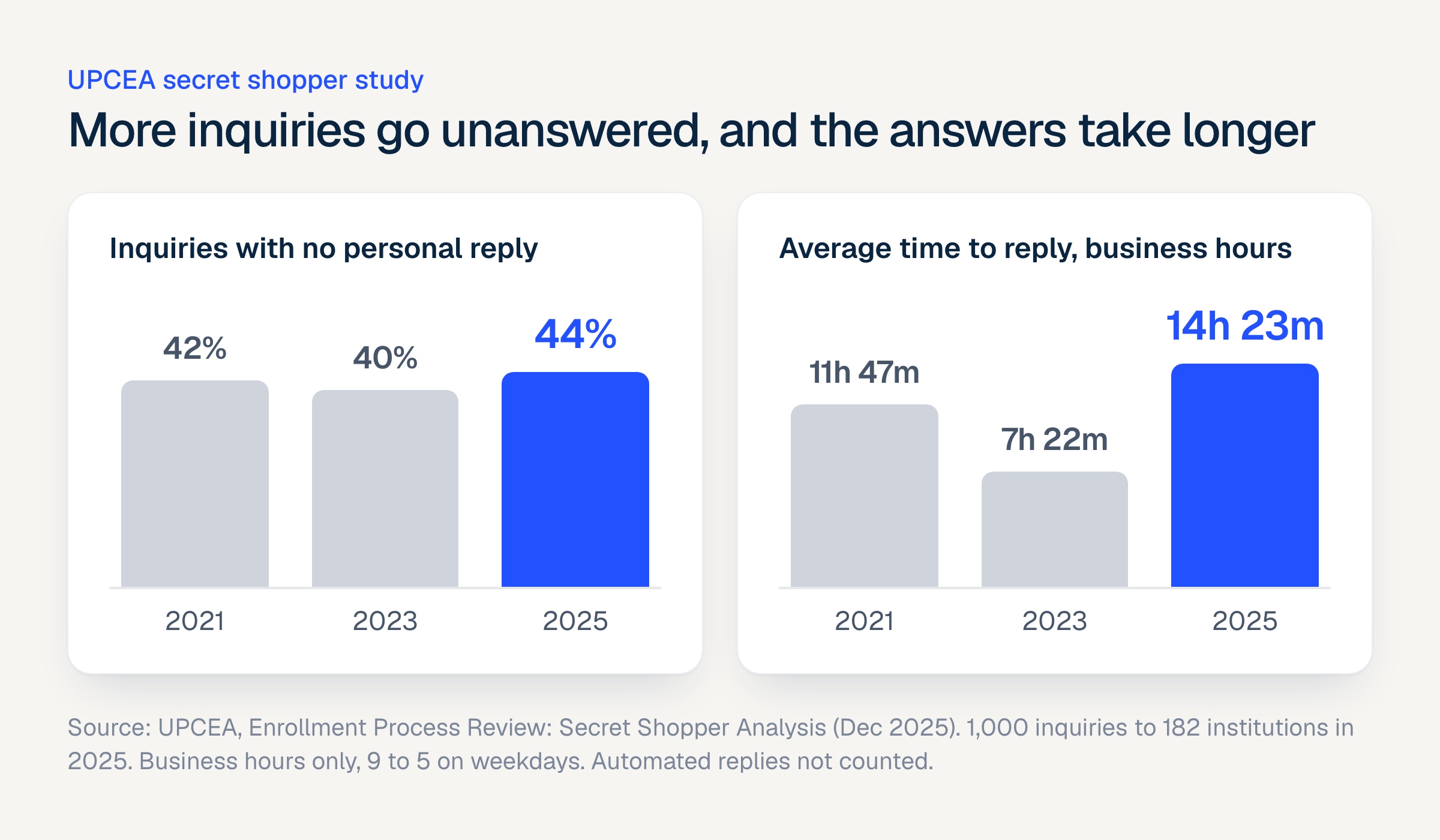
The problem these tools are trying to fix is getting worse. In UPCEA's December 2025 secret shopper study, staff sent 1,000 inquiries to programs at 182 institutions. 44% got no response at all, up from 40% in 2023. Among inquiries that did get answered, the average response time was 14 hours and 23 minutes, nearly double the 2023 average of 7 hours and 22 minutes. UPCEA only counted business hours, 9 to 5 on weekdays, so 14 hours means about two working days. It also ignored automated replies, so an autoresponder doesn't change these numbers. Meanwhile, RNL's 2023 graduate research found that more than 60% of graduate students will likely or definitely enroll in the program that responds to their inquiry first. Speed and follow-through decide a lot of enrollments, and the four categories below handle both very differently.
What kinds of AI for admissions are being sold in 2026?
Strip away the branding and you'll find four product shapes. Many vendors blend them, so judge the product by what it does, whatever the vendor calls it.
1. Website chatbots and knowledge-base bots
A chatbot lives on your website, application portal or student hub. It answers questions from a knowledge base you load with program pages, tuition, deadlines and admissions requirements. Newer ones use large language models, so they handle free-form questions much better than the old decision-tree bots.
The good part is that chatbots catch students at a high-intent moment, often at night. EAB found that 75% of student-facing chatbot queries in one 90-day period arrived outside business hours, with 43% between 6 p.m. and 11 p.m. That figure covers student-facing chatbots in general, not only admissions bots. Still, a chatbot that answers at 10 p.m. beats a contact form that waits until morning.
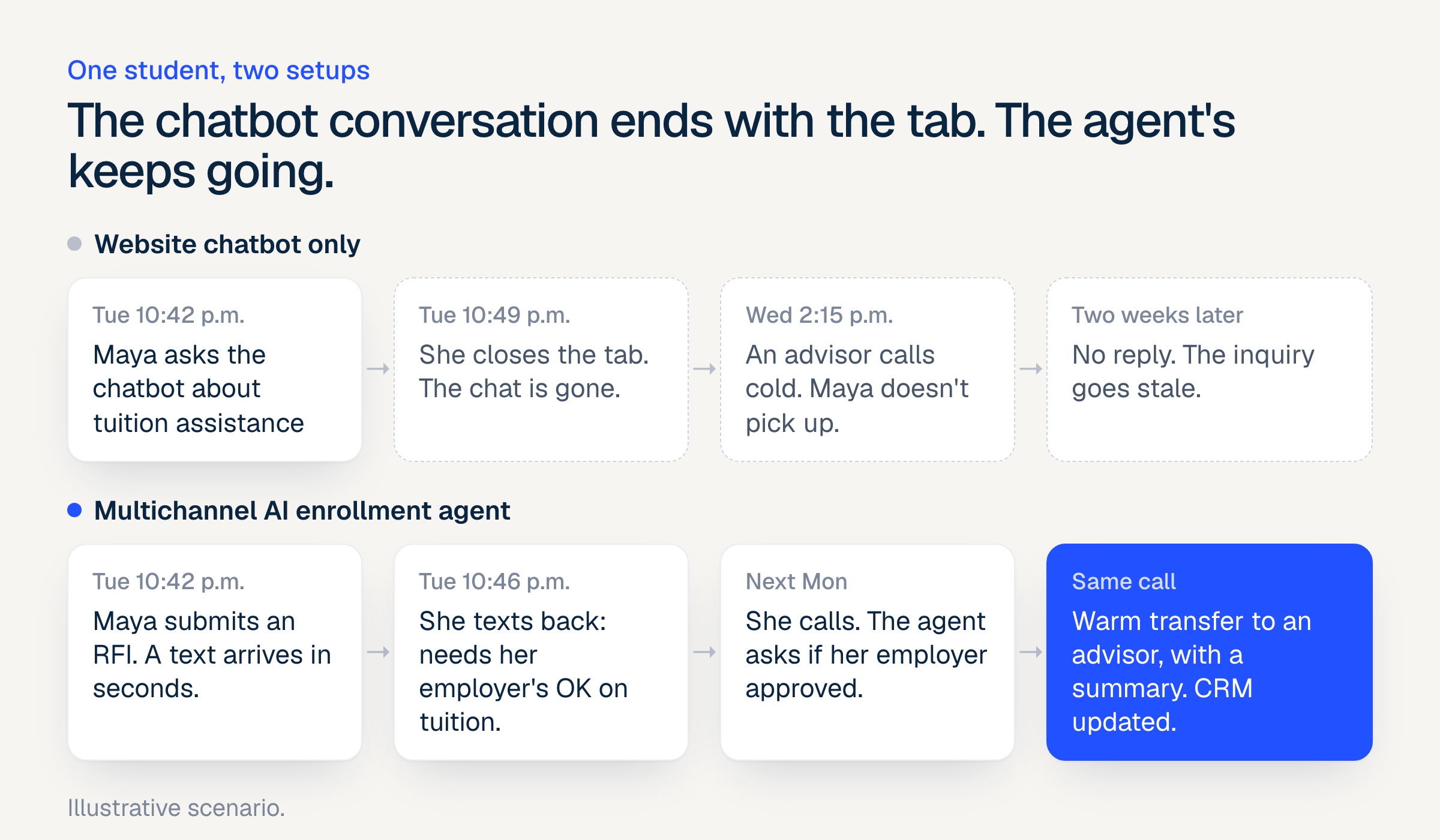
The limit is that chatbots are passive. They only talk to students who come back to the site and open the widget. They don't follow up on an RFI, they don't text a student who went quiet, and the conversation usually ends when the browser tab closes. If the bot never sends the transcript to your CRM, an advisor calling the next day starts from zero.
2. SMS texting platforms with staff inboxes
Two-way texting platforms give admissions staff a shared inbox for texting students, plus scheduled campaigns for deadlines and events. Some now add AI-drafted replies or auto-responses to common questions.
Texting platforms are good at reaching students where they actually read messages, and they keep a human in every conversation. For a small team that can work its inbox during the day, that is a real strength.
The problem is coverage. A staff inbox moves only as fast as the staff behind it, and a text that arrives at 9 p.m. on Friday waits until Monday. Campaign blasts also produce a lot of replies that someone has to answer by hand. And texting is its own silo. The texting tool doesn't know what the student said on the phone with an enrollment coach.
3. AI voice agents and AI dialers
This is the newest category in admissions. Several of these products come from horizontal voice-AI companies that sell into many industries and have added higher ed as a vertical. They answer inbound calls with a natural-sounding voice, call new RFIs, and work through aged-lead lists far faster than a human call center can.
Voice agents are good at volume and at covering the phones after hours. For institutions whose enrollment model is built around phone conversations with enrollment coaches, a voice agent can qualify a student and book or transfer the call without a person dialing. The tradeoffs of automated calling against human callers are covered in AI dialers vs human reps.
The weak spot is that they're voice-only. Many students don't answer calls from unknown numbers, and an unanswered call teaches the system nothing. UPCEA's shoppers left a phone number on about half of RFIs, and only 24% of those logged an identifiable call from the institution within 30 days, while 29% got a text. When a voice agent can't hand the student to text, or doesn't remember the text thread when the student calls back, the student gets a disconnected experience. AI-voice calls also carry specific legal requirements. In February 2024 the FCC confirmed that AI-generated voices count as "artificial" voices under the TCPA, so the consent rules for prerecorded calls apply to them.
4. Multichannel AI enrollment agents
A multichannel enrollment agent combines the other three and adds memory. It reaches out first when an RFI comes in, answers inbound texts, calls, emails and chats, and keeps one record of everything the student has said on every channel. It can move a text conversation to a live call when the student is ready, warm-transfer to an advisor with a summary, and write the outcome back to the CRM. The longer explainer on AI enrollment agents in higher education covers the workflow end to end.
Multichannel agents are good at the follow-through that the UPCEA data shows institutions are missing. Every RFI gets a fast first touch and persistent, two-way follow-up on the channel the student actually uses. That last part matters for online programs. Adult learners often prefer email, some will only text, and some want a phone call before they apply.
Here's what that looks like in practice. In Apten's data from 14 schools over the last 90 days (July to October 2026), the first reply to a new inquiry went out in 7 seconds at the median school, and 98% of new inquiries got a reply within a minute. Text often leads to a call. At the typical school, about 1 in 4 students who replied by text moved to a live phone call (median 26%). At the best schools it was about half. A voice-only tool never gets those students on the phone, and a chatbot never starts the conversation.
The costs are real. A multichannel agent takes more setup than a chatbot: CRM integration, guardrails, escalation rules and a decision about which conversations go to humans. It also touches more compliance surface, because it texts and calls. A vendor who calls this "plug and play" is underselling the work.
How do chatbots, texting platforms, voice agents and AI enrollment agents compare?
Here's how the four categories typically compare. Individual products vary, which is why the demo questions further down matter.
| Criteria | Website chatbot | SMS texting platform | AI voice agent / dialer | Multichannel AI enrollment agent |
|---|---|---|---|---|
| Proactive or reactive | Reactive. Waits for the student to open the chat. | Both, but proactive outreach is campaigns staff schedule. | Proactive on outbound calls, reactive on inbound. | Proactive and reactive. Contacts new RFIs and answers replies. |
| Channels | Webchat | SMS, sometimes MMS | Phone | SMS, voice, email, webchat |
| Shared memory across channels | Usually none beyond the session | Text history only | Call history only | One record across every channel |
| After-hours coverage | Yes, for students on the site | Limited to staff hours unless auto-replies are set | Yes, on the phone | Yes, on every channel |
| Human handoff | Form or ticket, sometimes live chat | Staff already own the thread | Call transfer | Warm transfer by call or text, with a summary |
| CRM write-back | Varies, often transcripts only | Usually logs texts | Varies, often call notes | Should write activities, status and next steps |
| Compliance controls | Content guardrails | Opt-outs and quiet hours for texts | Calling hours, AI voice consent, opt-outs on calls | Opt-outs, quiet hours and guardrails applied across channels |
| Typical use case | FAQ deflection on the website | Staff-run texting and event reminders | After-hours phones and aged-lead calling | High-volume RFI follow-up, re-engagement and booking |
Look hardest at the third row. Most tools can send a message on more than one channel. Far fewer let the conversation continue across channels. A student who texts "I need to talk to my employer about tuition assistance first" and then calls a week later should hear that on the call. More on why that matters in voice and SMS in the same thread.
Which vendors sell each kind of admissions AI?
Here are vendors you'll likely run into, sorted by the category their product fits best. Each description comes from the vendor's own website as of October 2026. Several of them span more than one category, and products change fast, so confirm what's live in a demo. This list isn't complete and isn't a ranking.
| Vendor | Closest category | What the vendor says it does |
|---|---|---|
| Ivy & Ocelot (Gravyty) | Chatbot and knowledge-base bot | AI assistant that answers student questions 24/7 over chat, text, email, WhatsApp and social media |
| Mongoose | Texting platform | Two-way engagement over text, WhatsApp and web chat alongside your CRM. Staff-facing AI agents today, with student-facing agents listed as in development |
| Mainstay | Texting platform | AI-assisted student success coaching over SMS, web chat and social media |
| Retell AI | Voice agent | Platform for building, testing and deploying AI voice agents that handle phone calls |
| Bland | Voice agent | Enterprise voice AI platform for phone agents, also deployable on SMS and web |
| CloudTalk | Voice agent | Call center software with AI voice agents that qualify prospects and make enrollment follow-up calls |
| Element451 | Multichannel agent | AI-native higher ed CRM. Its Bolt agents answer texts and chat, with phone calls listed as beta in some of its docs, inside Element's CRM or alongside another one |
| CollegeVine | Multichannel agent | AI Recruiter that handles inquiries over phone, email, text and chat and can reach out first |
| Apten | Multichannel agent | AI enrollment agent over SMS, voice, email and webchat, with one conversation record, warm transfer and CRM write-back |
Your CRM, whether that's Slate, Salesforce or Dynamics, is a separate decision. Most of these tools sit on top of it, so ask each vendor what it reads from the CRM and what it writes back.
When is a simple admissions chatbot enough?
Sometimes the cheapest option is the right one. A chatbot is probably enough if:
You get a few hundred inquiries a month, not thousands, and staff answer every RFI the same day.
Most questions are informational, like deadlines, tuition, prerequisites and transfer policies.
Your enrollment model doesn't depend on phone conversations with enrollment coaches.
You don't have a large backlog of aged or closed-lost leads worth re-engaging.
In that case, put your effort into a good knowledge base and make sure every chatbot conversation reaches the CRM. If your team can't keep up with RFI follow-up, though, a chatbot won't fix it. UPCEA found that 37% of RFI form inquiries got no response, and a chatbot never touches those students.
Which do you need? A decision guide by situation
Start from your operating model, not the product category.
High-volume RFIs and a call center of enrollment coaches. You need a multichannel agent. The volume makes instant first touch impossible to staff, and coaches are expensive to spend on dialing students who don't pick up. Let the agent make first contact, qualify by program of interest and start term, and warm-transfer ready students to a coach.
Phones ring after hours and nobody answers. A voice agent solves the immediate gap. Before you buy, check whether it can follow up by text when a call is missed and whether the text thread and the call share one record. If not, you'll have solved the phone problem and created a new memory gap.
A big database of aged or closed-lost leads. Re-engagement works best text-first, with a call once the student replies. Dialer-only re-engagement burns through lists without learning much. A multichannel agent can open by text, answer questions and escalate to a live call. This is the same logic behind replacing drip campaigns with AI agents.
A small team that wants to keep humans in every conversation. A two-way texting platform fits, as long as someone owns the inbox evenings and weekends or you accept that those messages wait.
Mostly website traffic and informational questions. A chatbot, connected to your CRM.
Already happy with your chatbot. Keep it. Add an agent for outbound follow-up, and make sure the chatbot conversation lands in the same student record the agent reads from.
Many institutions end up with more than one of these. That's fine, as long as one system holds the full conversation. The case for unifying channels is laid out in more detail in omnichannel AI in 2026.
Where should an AI admissions agent stop?
An agent that acts on its own needs clear limits. These are the ones we'd set before launch.
No admissions decisions. The agent can collect documents, answer checklist questions and report application status. Whether a student gets in stays with your staff.
No promises about money or outcomes. Aid amounts, transfer credit evaluations and job placement are where an improvised answer turns into a complaint. Route those questions to a person, or answer only from approved text.
Say it's an AI. Tell students up front and give them an easy way to reach a human. California, for one, bars bots from hiding that they're bots to influence a sale. And students who find out later trust you less.
Check identity before touching records. FERPA protects the education records of students who enroll. A prospect who never enrolls generally isn't covered, but once the agent can look up application status or talk to admitted students, verify who's asking before it shares anything.
Hand off when the student is upset or stuck. Two confused replies in a row, or any sign of distress, should go to a person.
How are admissions AI tools priced?
Vendors price these tools in very different ways, which makes side-by-side quotes hard to compare. You'll mostly see four models.
Annual platform license. Common for CRM-based products, usually scaled by enrollment or student records. Element451, for example, publishes annual pricing based on institution size and support tier, with plans starting at $20,000 a year.
Per minute. Common for voice platforms. Retell publishes pay-as-you-go rates of $0.07 to $0.31 per minute, and Bland bills a single per-minute rate.
Per seat plus usage. Call center software often charges per staff user, then bills AI minutes separately. CloudTalk lists plans from $25 per user per month, billed annually.
Per contact or per conversation. You pay by the number of students engaged or conversations handled, so cost tracks inquiry volume.
Prices above are as listed on each vendor's site in October 2026. Whatever the model, ask what's left out. Carrier SMS fees, phone numbers, A2P 10DLC registration, CRM integration and implementation hours can add a lot to the first-year cost.
What should you ask in an AI admissions agent demo?
Every vendor shows the happy path. These questions test the parts that break in production. Ask to see each one live, not on a slide.
If a student texts, then calls, does the agent know what they said by text? Have someone on your team text a question, then call the same number, and listen for whether the agent picks up where the text left off.
Can the agent move a text conversation to a live call mid-thread? Who places the call, the AI or an advisor, and how fast?
How fast is the first touch on a new RFI at 11 p.m. on a Saturday? Submit a test RFI during the demo and time it.
What does the advisor see on a warm transfer? Ask for the summary format, and ask what happens when no advisor is available.
What gets written back to Salesforce or Dynamics? Ask to see the actual record afterward: activities, transcripts, status changes, booked appointments.
Does a STOP by text also stop calls and emails? Ask how opt-outs sync back to your CRM. Since April 2025, the FCC has required callers to honor TCPA opt-outs made by any reasonable means, and a text reply counts. A separate "revoke-all" rule, which would make one opt-out cover every kind of automated call and text you send, is delayed until January 31, 2027. Email isn't covered by the TCPA at all. A student who texted STOP won't care which law applies, though, so ask whether one opt-out can shut off every channel.
Do quiet hours follow the student's time zone? Online programs enroll nationally, so an 8 p.m. Eastern send is 5 p.m. Pacific.
Can you set guardrails on what the agent says, and are they checked before a message sends? Test it with questions about financial aid, transfer credit or job outcomes, where an over-promise creates real risk.
What does the agent do when it doesn't know an answer? The right behavior is to say so and route to a human, not to improvise.
Who is responsible for consent and Do Not Call scrubbing? In most setups that's the institution. A good vendor tells you plainly what it does and doesn't handle.
Is student data used to train models, and can you see the SOC 2 report? Ask what the vendor will sign to support your FERPA obligations, such as a data processing agreement that limits how student data is used.
This isn't legal advice. Run your outreach program, especially AI voice calls and texting consent, past your counsel.
How Apten approaches AI for admissions
Apten is a multichannel AI enrollment agent, built for online programs and large enrollment teams. It has handled over 18 million messages and 4.7 million calls. One agent talks with each student over SMS, voice, email and webchat, and it remembers everything across all four. A student who asked about clinical placements by text gets a call that starts with clinical placements.
When an RFI comes in, the agent replies in seconds, day or night. It answers program questions from the material you approve, books info sessions and advisor appointments, and follows up on checklist items like transcripts and the application fee. When a student is ready to talk, it can move them from a text thread to a live call, or warm-transfer them to an admissions advisor with a summary of the conversation so far.
Every interaction writes back to your CRM, including Salesforce and Microsoft Dynamics. Guardrails you define are checked before any message sends. Opt-outs are honored across channels and can sync back to your systems by webhook, and quiet hours apply to outreach. Apten has completed a SOC 2 Type II audit and encrypts data at rest and in transit. We also help institutions get A2P 10DLC registration approved for texting. Consent capture and DNC scrubbing stay with your team.
If you're comparing categories right now, bring the demo questions above to a call with us. We'd rather show the text-to-call handoff live than describe it.
The bottom line
Start with two numbers from your own CRM: inquiries per month, and the share that get a human reply the same day. If volume is low and the same-day share is high, a chatbot connected to your CRM may be all you need. If either number looks like UPCEA's, you need something that goes to the student instead of waiting for them. Before you sign anything, run the text-then-call test from the demo list yourself.
Book a 20-minute demo to see an Apten agent move a student from text to a live call, or learn more at apten.ai.
Sources
UPCEA, Enrollment Process Review: Secret Shopper Analysis (December 2025)
RNL, Lead to Enrollment and the Importance of Speed to Lead for Graduate and Online Students
EAB, What Are Students Asking University Chatbots? (October 2025)
FCC, Declaratory Ruling on AI-Generated Voices Under the TCPA, FCC 24-17 (February 2024)
Kelley Drye, FCC Sets Effective Date for TCPA "Reasonable" Consent Revocation Rules
Burr & Forman, The FCC Delays Effective Date of TCPA Revoke-All Rule Until January 31, 2027
Vendor descriptions and published pricing: Gravyty Ivy & Ocelot, Mongoose, Mainstay, Retell AI pricing, Bland, CloudTalk, Element451 pricing, Element451 Bolt voice mode, CollegeVine AI Recruiter (all accessed October 2026)
Apten platform data, 14 schools with 500+ real-time inquiries, Jul 28–Oct 25 2026, bulk imports excluded