An AI enrollment agent should hand a student to a human admissions advisor the moment the conversation needs judgment, authority or reassurance the AI shouldn't fake. That covers high intent ("I'm ready to apply"), financial-aid and transfer-credit specifics, eligibility edge cases, frustration, sensitive topics, a direct request for a person, and any question outside the AI's approved knowledge. The best handoff is a warm transfer. The AI briefs the advisor first, then connects the student, so nobody repeats themselves.
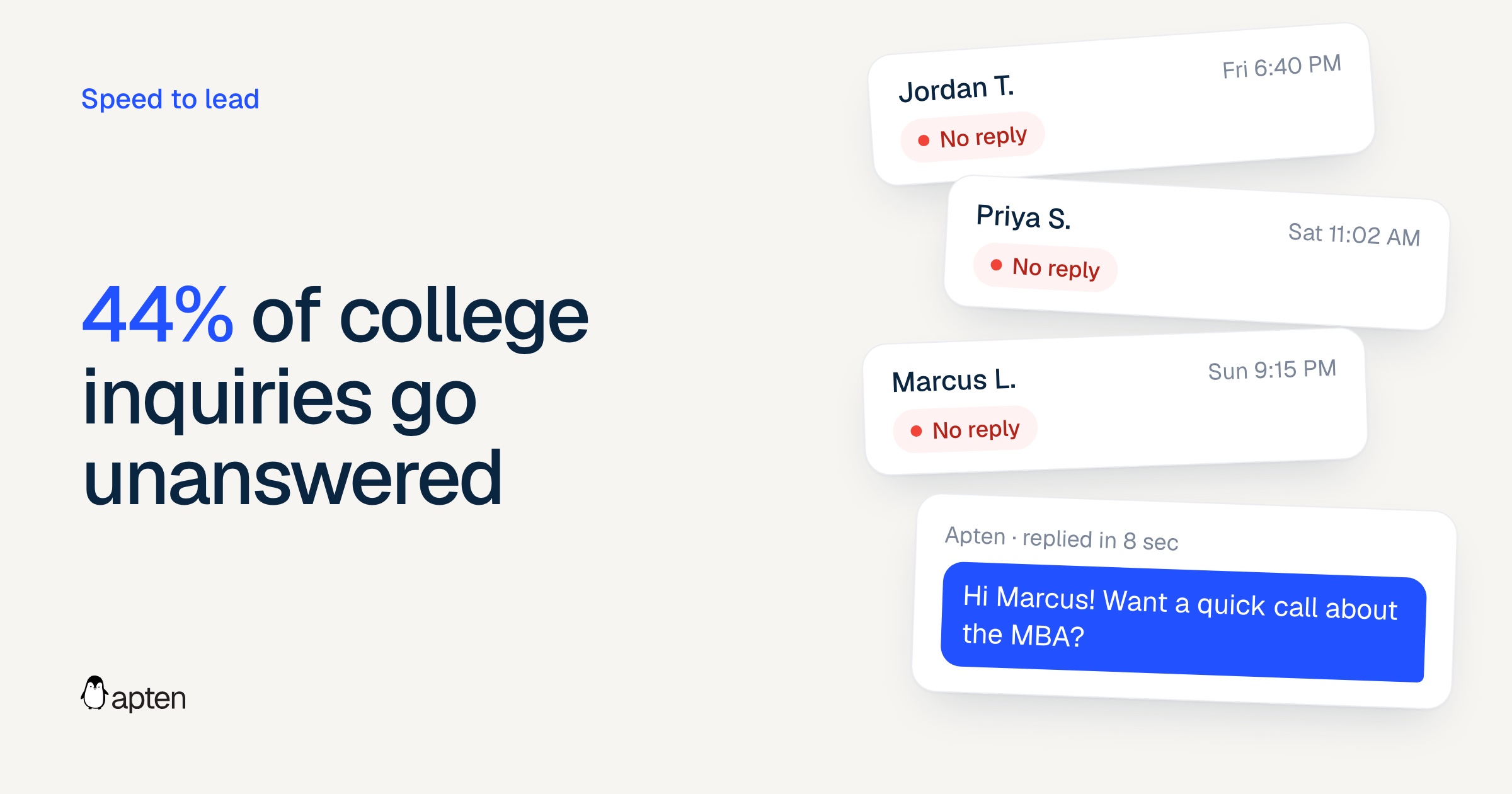
The baseline is low. UPCEA's December 2025 secret shopper study sent 1,000 inquiries to member institutions. 44% got no response at all, up from 40% in 2023. Responses that did arrive took an average of 14 hours and 23 minutes, almost double 2023's 7 hours and 22 minutes. The median was 3 hours and 18 minutes, close to prior years, so the typical reply didn't get slower. The slow tail got longer. And 62% of emails sent to individual staff went unanswered. If you're adding an AI agent to fix that, the handoff to your enrollment coaches can't be where it breaks.
This is a playbook for online-university enrollment teams. It covers when to hand off, which handoff to use, what the advisor needs to see, what to do when nobody's free, how to route, and how to measure it. For the broader case for AI in admissions, see our guide to AI enrollment agents in higher education.
When should an AI hand off to a human admissions advisor?
Write your handoff triggers down before launch. Vague rules like "escalate when needed" produce an AI that either never lets go or hands off everything. These seven triggers cover most of what an online program sees.
1. High intent
"I'm ready to apply." "What's the next step?" "Can I still make the January start?" These are your best moments, and the AI shouldn't sit on them. If an advisor is free, connect the student now. If not, book a specific time and send the application link in the meantime.
2. Financial aid and transfer credit specifics
The AI can explain that FAFSA exists, list deadlines and say the program accepts transfer credit. It shouldn't estimate a student's aid package or promise that 45 credits from a community college will transfer. Those answers carry real money and real consequences. Wrong ones turn into complaints, or worse.
3. Eligibility edge cases
An expired RN license, a foreign transcript, a GPA just under the cutoff, a military transfer. Your published admissions criteria cover the common case. An advisor handles the rest.
4. Frustration or confusion
Repeated questions, short angry replies, "this isn't helping," or the same question rephrased three times. A good agent notices and offers a person before the student asks.
5. An explicit request for a person
"Can I talk to someone?" gets a yes, every time. Don't make the AI argue or try one more answer first. Students who have to fight for a human remember the fight, and they tell people about it.
6. Sensitive topics
A recent layoff, a disability accommodation, a death in the family, a past withdrawal. The AI can respond with care, but these conversations belong with a person.
7. Anything outside approved knowledge
This one matters most. The AI should answer from your approved program content and nothing else. When a question falls outside it, the right answer is "I don't know, but I can get you to someone who does." A confident guess about accreditation or clinical placement does more damage than a slow answer.
Some vendors argue the opposite. In their view a knowledge gap is a content problem, and the fix is better training, not an advisor's time. They're half right. If students keep asking when the spring term starts or how many courses a program has, log the question and add the answer. Don't burn advisor time on it. But money, credits, eligibility and licensure are different. No amount of content makes it safe for the AI to guess at a single student's case, and those questions should go to a person every time.
What's the difference between a cold transfer, a warm transfer and a scheduled callback?
There are three handoff types. Pick the one that matches the moment.
Cold transfer. The AI routes the student's call straight to an advisor's line with no briefing. It's fast, and it fits simple cases like "connect me to the registrar." The advisor answers blind, though, and usually starts with "How can I help you?"
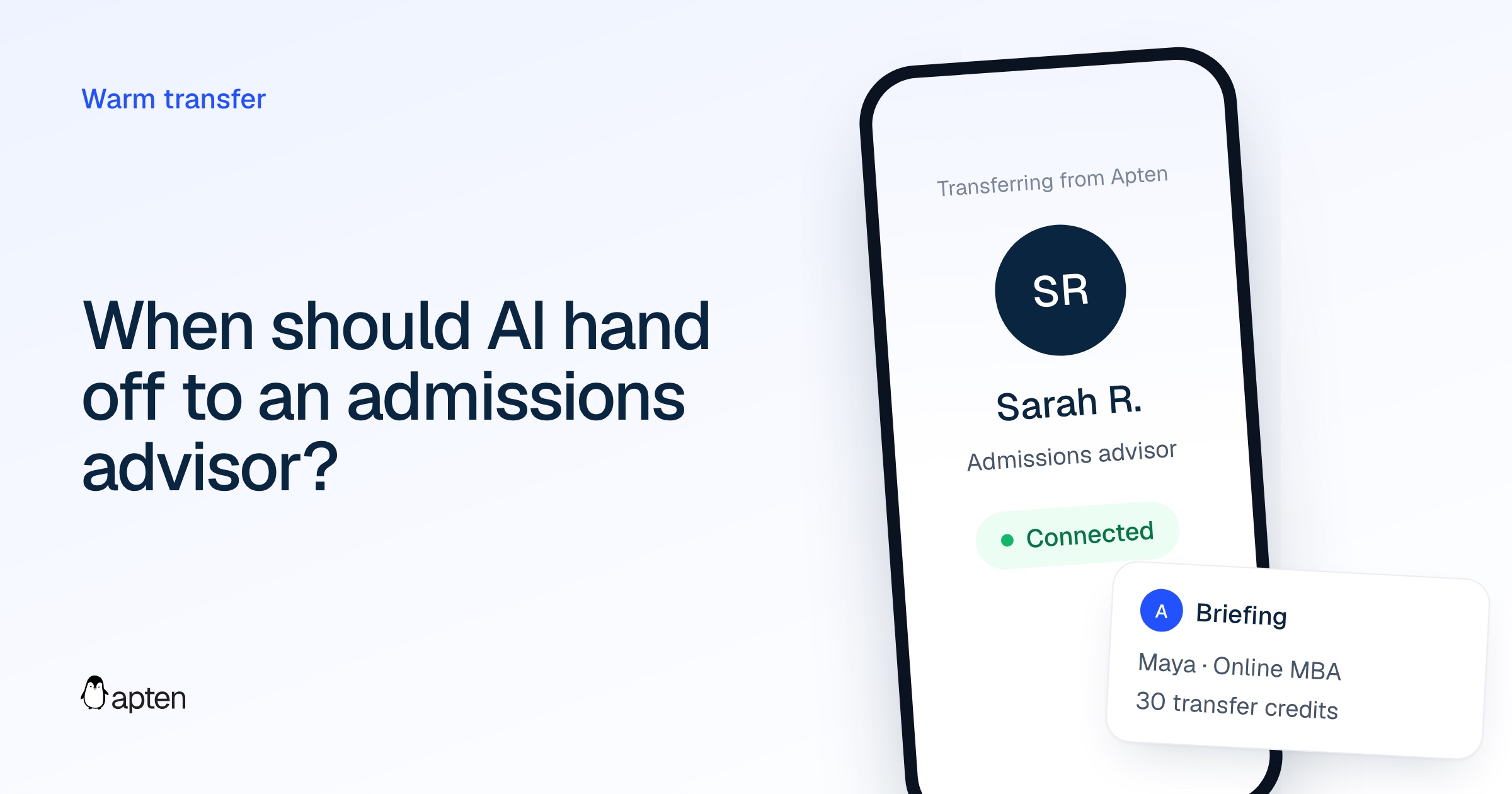
Warm transfer. The AI puts the student on a short hold (or keeps talking with them), calls the advisor, briefs them, waits for them to confirm, and then joins everyone on a live call. This is the default for high-intent and complex conversations.
Scheduled callback. The AI books a specific time with an advisor, confirms it by text and sends a reminder. Use it when nobody is free, when it's after hours, or when the student would rather talk later.
Can AI switch from text to a phone call mid-conversation?
Yes, and for online learners this is often how the handoff starts. Most adult students begin by text, email or webchat because they're fitting school research around work and family. When the conversation turns serious, the agent offers a call. The student taps yes, the phone rings within seconds, and the voice conversation picks up where the text thread stopped. From there the AI can warm-transfer to an advisor.
Students take that offer more often than you might expect. In Apten's data from 14 schools over the last 90 days (July to October 2026), about 1 in 4 students who replied by text moved to a live phone call at the typical school (median 26%). At the best schools it was about half. Those calls are the handoffs your advisors should be ready for.
That only works if text and voice share one memory. Separate tools for SMS and calls break it, because the voice bot doesn't know what the student just typed. We cover the architecture in voice and SMS in the same thread.
Handoff triggers at a glance
| Trigger | Handoff type | What the advisor sees |
|---|---|---|
| "I'm ready to apply" / "What's next?" | Warm transfer now; callback if no one is free | Program, start term, checklist items done and missing, application link status |
| Financial aid amount questions | Warm transfer or callback with a financial aid advisor | Aid questions asked, FAFSA status if known, employer tuition benefit mentioned |
| Transfer credit evaluation | Scheduled callback (transcripts usually needed) | Prior institutions, approximate credits, whether transcripts were requested |
| Eligibility edge case | Warm transfer | The specific criterion in question and the student's exact words |
| Frustration or confusion | Warm transfer, AI stays on the line | Summary plus a note that the student is frustrated and why |
| "Can I talk to a person?" | Warm transfer; cold if the student wants speed | Full summary and the question that prompted the request |
| Sensitive personal topic | Scheduled callback with a named advisor | A short, discreet note, not a transcript readout |
| Outside approved knowledge | Warm transfer or callback | The unanswered question, flagged so content can be added later |
What does an SMS-to-call warm transfer look like?
Here's an illustrative example. The student, program and school are invented, but the flow is what a well-configured agent should do.
[SMS, 7:42pm Tuesday]
Student: hi, I filled out the form for the RN to BSN. how long does it take if I work full time?
AI: Hi Maria, thanks for reaching out. Most working nurses take the RN to BSN in about 12 to 18 months at one or two courses per term. Are you aiming for a particular start?
Student: january if possible. I have an associate degree from 2014, do those credits count?
AI: Your ADN should count toward the program, but exactly which credits transfer is something an admissions advisor confirms. I'd rather not guess. One is available right now. Want me to call you so you can talk it through?
Student: sure
[Call, 7:44pm]
AI: Hi Maria, it's the assistant from the texts. I'm connecting you with Jordan from admissions. I've shared what you told me, so you won't need to start over. One moment.
[AI to advisor, student on hold] Maria Lopez, RN to BSN, wants the January start, works full time. ADN from 2014. Her question is how many credits transfer. She hasn't started an application. Ready?
Advisor: Ready.
Advisor: Hi Maria, Jordan here. I hear you've got an ADN from 2014 and you're looking at January. Let's talk about your credits.
Maria texted at 7:42pm and was talking to an advisor at 7:44pm, and she didn't repeat a single detail. The AI also held back on the transfer-credit answer. That's the behavior to look for in demos.
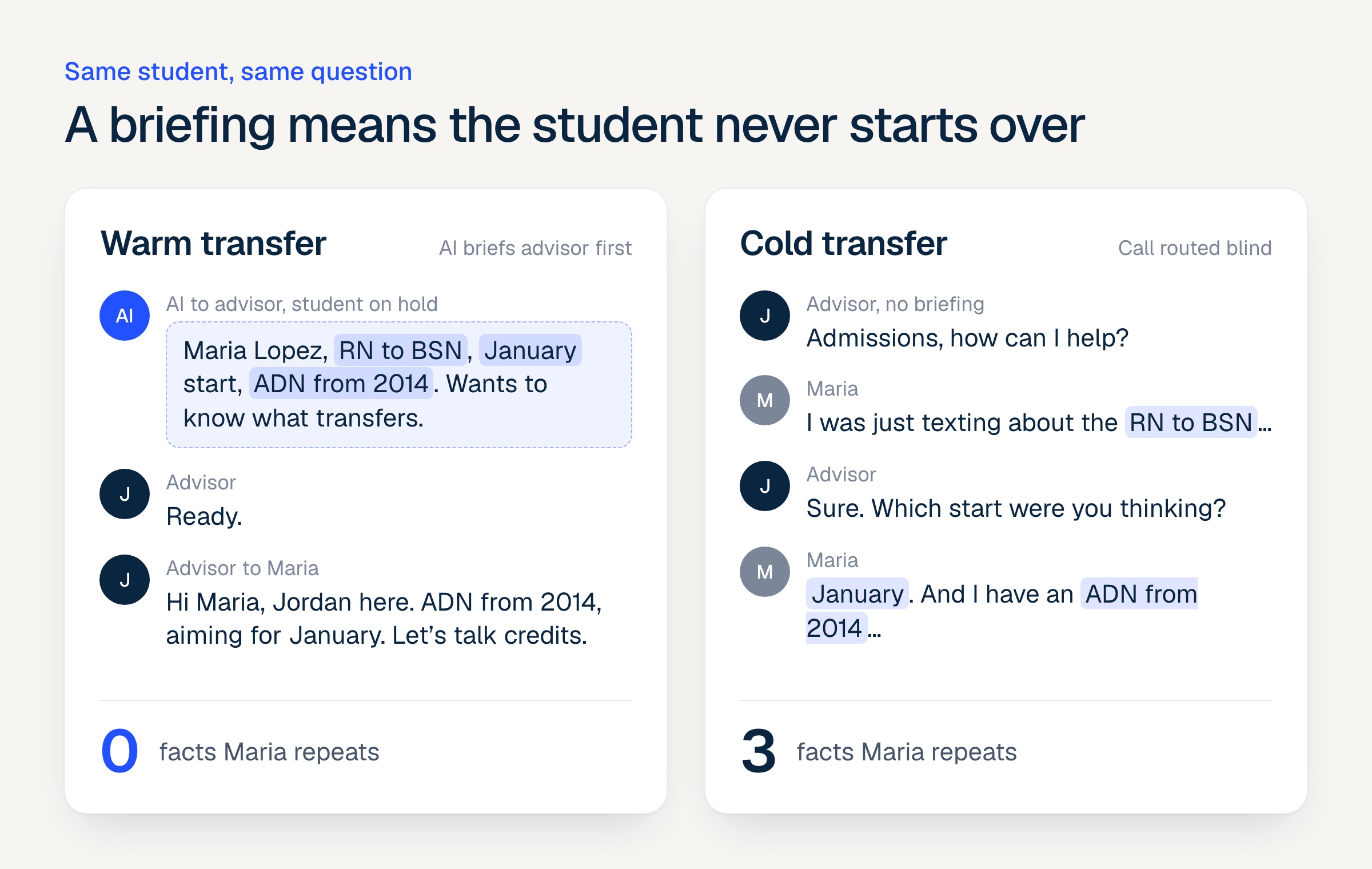
What must the advisor receive so the student never repeats themselves?
Twilio surveyed 2,000 US consumers in 2022, and 45% named repeating their issue to a new representative after a transfer or disconnect as their most annoying support problem. A student who explains their situation to an AI and then again to an advisor has the same experience, and every retelling costs you some goodwill.
Every handoff should carry:
Identity and contact details. Name, phone, email and the CRM record ID.
Program of interest and start term. The two fields that shape the whole advising conversation.
A short summary. Three to five sentences on what the student asked, what the AI answered and what's still open.
The trigger. Why the handoff happened: an aid question, a request for a person, frustration.
Checklist status. Application started or not, app fee, transcripts requested.
Channel history. Did this start as an RFI, a text, webchat or an email reply? It tells the advisor how the student likes to communicate.
Deliver it twice. First as a spoken briefing in the warm transfer, so the advisor hears it before the student joins. Then as a written record in Salesforce or Dynamics (a screen pop, if your call center software supports it), so the advisor can look back mid-call. After the call, the advisor's notes should flow back to the AI, so its next text reflects what the advisor promised. The memory problem is why most AI agents fail here. They lose context between channels and between the bot and the human.
What happens when no advisor is available?
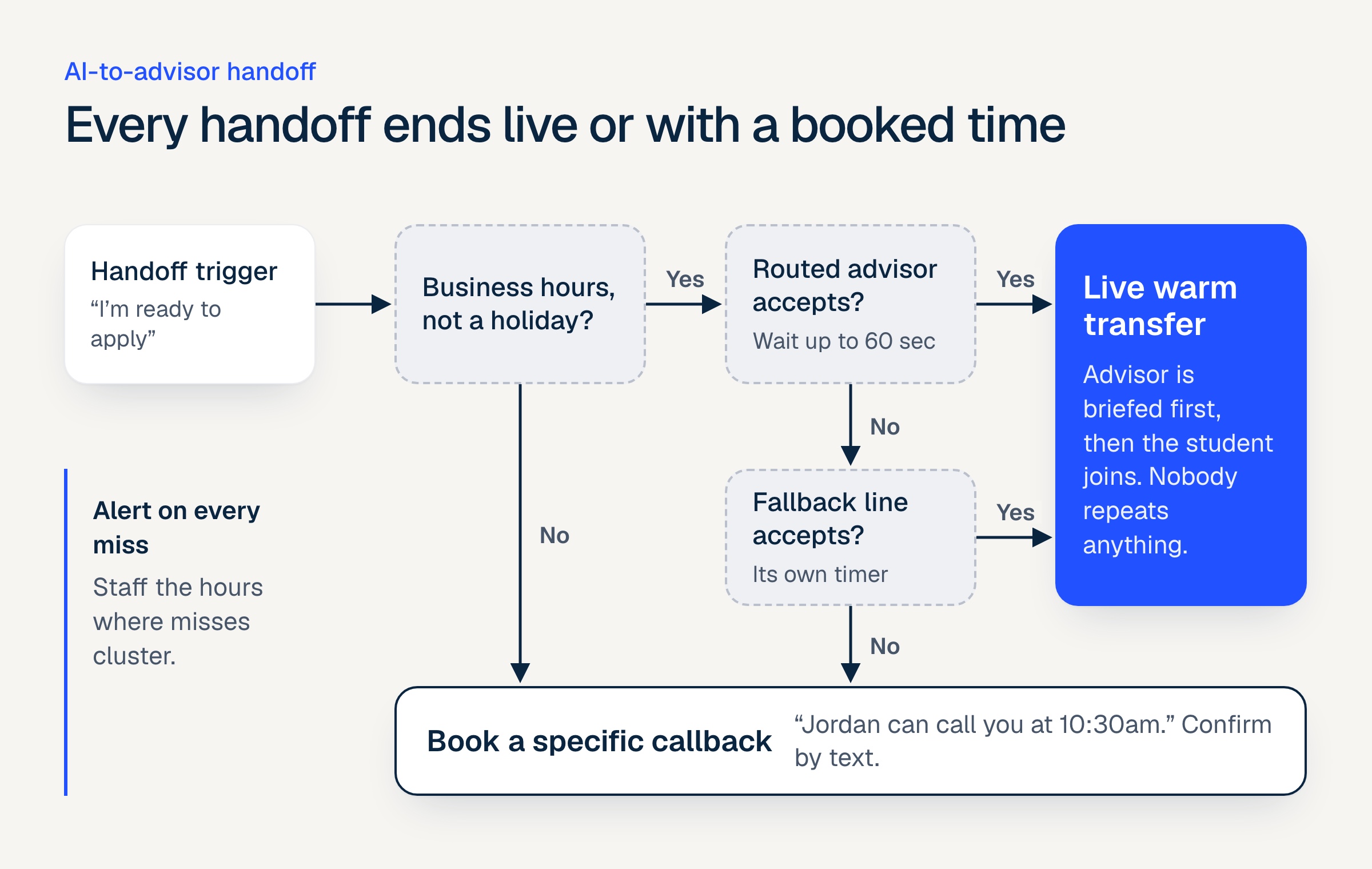
It will happen. Advisors are on other calls, it's 10pm, it's a holiday, the queue is full at the start of a term. The fallback decides whether the student hears "nobody's here" or gets a plan.
Set a short timeout. Decide how long a student waits on hold while the AI tries to reach an advisor. Somewhere under a minute is reasonable for most teams. Long hold music after an instant text exchange feels like a bait and switch.
Try a fallback line. If the assigned advisor doesn't pick up, try a team line or the on-call advisor.
Keep the AI in the conversation. If nobody answers, the AI should still be on the line to say so and keep helping, rather than dropping the student into a voicemail box.
Book a specific callback. Say "Jordan can call you tomorrow at 10:30am, does that work?" and avoid "someone will reach out." Confirm by text right away and send a reminder before the call.
Respect business hours and holidays. After hours, the AI shouldn't attempt a live transfer at all. It should go straight to booking.
Alert on misses. Every failed transfer should notify a manager or post to a channel. If misses cluster on Tuesday evenings, staff Tuesday evenings.
Missed callbacks deserve the same attention as missed calls. If an advisor doesn't make the booked call, the student should get an apology and a new time by text, not silence. Silence after a promise is how warm students go cold, and it's one reason admissions connect rates keep falling.
How should AI route students to the right advisor?
A warm transfer to the wrong advisor is just a slower cold transfer. Route on the fields the AI already collected:
Program. Nursing, MBA, IT and education often have dedicated enrollment coaches who know the prerequisites.
Campus or modality. Online-only, hybrid or a specific site.
State. State authorization and licensure rules differ, especially for nursing, teaching and counseling programs. Route to advisors who know which states a program can enroll from.
Language. If you staff Spanish-speaking advisors, route Spanish conversations to them.
Owner. If the student already has an assigned advisor in the CRM, send them back to that person whenever possible.
Keep it simple at first. A routing table with five rules that the team understands beats forty rules nobody can debug.
Which metrics show whether your handoffs work?
Most teams measure the AI's conversations and the advisors' calls separately. The handoff falls between the two and goes unmeasured. Track these:
| Metric | What it measures | What a problem looks like |
|---|---|---|
| Transfer acceptance rate | Share of attempted transfers an advisor picks up | Low rate means staffing gaps or routing to the wrong lines |
| Speed-to-advisor | Seconds from handoff trigger to a live human | Long waits mean timeouts are too generous or fallbacks are missing |
| Callback show rate | Share of booked callbacks where the student answers | Low rate means confirmations and reminders aren't landing |
| Conversion after transfer | App started, app submitted and enrolled among transferred students | Flat conversion means the handoffs aren't moving students forward |
| Student repeat rate | Share of transferred calls where the advisor re-asks collected info | High rate means the briefing or CRM sync is broken |
Repeat rate is the one nobody tracks and the one students feel most. Have a manager review 20 transferred calls a week and count how often the advisor asks something the AI already knew. It takes an hour, and it'll tell you more than a dashboard.
Will students hate talking to AI in admissions?
The research says mostly no, as long as the bot works and a person is easy to reach. Nobody has run a clean independent study on adult learners and AI admissions agents yet, so here's what exists:
USC Aiken, 2019. In a vendor-published survey of its AdmitHub chatbot, 96% of students who paid a deposit found it helpful. So did 76% of students who chose not to enroll. The second number is the more honest one, because those students had no reason to be generous.
Sweden, 2024. A survey of 5,894 university students found more than half positive about chatbots in education, and almost as many worried about where they're heading. Students are split, not hostile.
A southwestern public university, 2021. A Northern Arizona University dissertation found that first-generation Hispanic students rated an enrollment chatbot's reminders and nudges more favorably than other students did. They also didn't enroll at higher rates. The bot helped with tasks, and the author concluded that students needed more support to get all the way to enrollment.
That last finding is the argument for handoffs. AI is good at speed and reminders, and students appreciate both. When they're deciding whether to enroll, they need a person. Two things make students dislike the AI. One is hiding that it's AI. The other is making them work to reach a human. Have the agent say it's an assistant in its first message, and treat "can I talk to someone?" as a trigger the AI can't argue with.
How Apten handles handoffs to admissions advisors
Apten's enrollment agents text, call, email and chat with students from one shared memory, and have handled over 18 million messages and 4.7 million calls. When a handoff is needed, Apten places the call to your advisor's existing phone number, cold, warm or scheduled. Advisors don't need a new phone system. A transfer can start from a voice call, an SMS thread or a webchat session, so a student who texts "can I talk to someone?" gets connected without the AI calling them first.
In a warm transfer, an AI transfer bot calls the advisor, briefs them with the student's name and a conversation summary, and connects the call once the advisor confirms they're ready. These are the settings that matter, per the warm transfer documentation:
| Setting | Default | What it does |
|---|---|---|
| AI transfer bot | On | Briefs the advisor before connecting. It uses voice detection to wait for a person, not voicemail or an IVR. You can add custom briefing instructions, or turn the bot off and use a keypress prompt instead. |
| Agent response timer | 60 seconds | How long Apten waits for the advisor to pick up and accept. The maximum is 30 minutes. |
| Fallback number | None | A second line Apten tries if the first advisor doesn't answer in time. It has its own timer. |
| Stay on the line while dialing | Off | Keeps the AI talking with the student instead of playing hold music. If no advisor picks up, the AI tells the student and keeps the conversation going. With this off, the student hears a missed-transfer message and the call ends. |
| Business hours and holidays | Per profile | Live transfers follow the profile's schedule. On a holiday, the AI won't start a live transfer by text or voice, and it tells the student. |
Each transfer fires a webhook with the transfer type, the CRM lead ID and a summary covering the call and earlier conversation. Missed transfers fire their own event, so you can alert on them. You can also write notification rules in plain English, such as "the lead asks to speak with a human," and Apten emails your team or calls a webhook when one matches. Custom guardrails check every message before it sends.
The takeaway
The AI handles speed and volume. Advisors handle judgment. Write down your seven triggers, make warm transfer the default, brief the advisor before the student joins, and always have a specific callback ready when nobody's free. Then measure the handoff itself, because that's where students decide whether your enrollment process feels human.
See an Apten warm transfer to an admissions advisor in a 20-minute demo
Sources
UPCEA: Enrollment Process Review: Secret Shopper Analysis (December 2025)
Chief Marketer: Twilio Survey: Top Consumer Pain Points When Dealing With Customer Support (2022)
Apten Docs: Changelog (stay on the line during warm transfers, holidays for live transfers)
Mainstay: Do students enjoy the chatbot experience? (USC Aiken survey, 2019)
Apten platform data, 14 schools with 500+ real-time inquiries, Jul 28–Oct 25 2026, bulk imports excluded