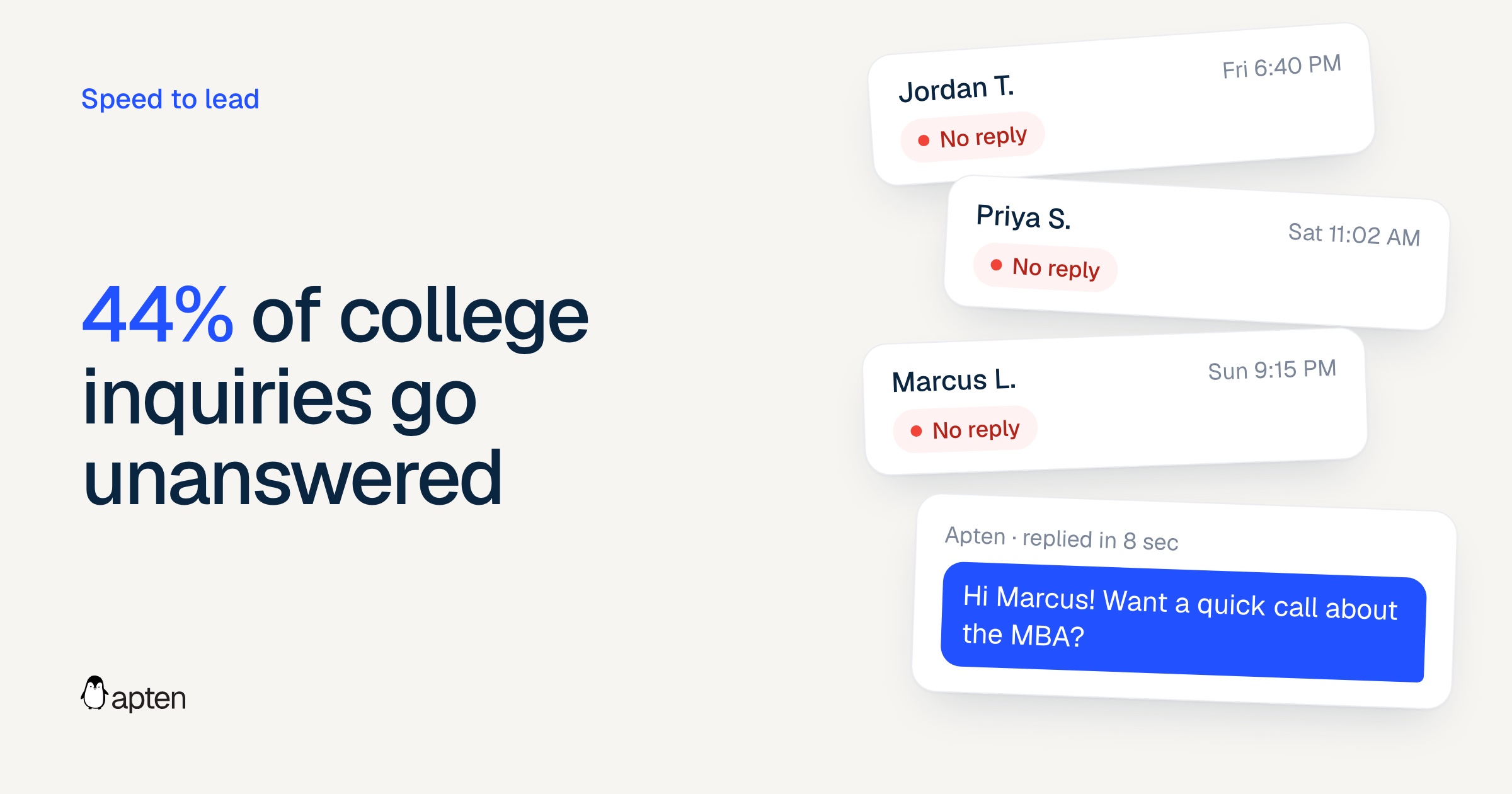
In UPCEA's December 2025 secret shopper study, 44% of inquiries to online and professional programs got no reply from a person, and the average response took 14 hours and 23 minutes of business time. The cause is structural: inquiries go to individual inboxes, staff work 9 to 5, and email inquiries rarely enter the CRM or a follow-up sequence. The fix is a first touch within minutes on every channel, after-hours coverage, and a 72-hour multichannel sequence that routes students to an advisor.
For online enrollment leaders, this is the cheapest pipeline you will ever recover. You already paid for the RFI. Then nobody answered.
For students who don't pick up the phone, see why admissions connect rates are falling. For general benchmarks, see speed-to-lead benchmarks for 2026.
What did UPCEA's 2025 secret shopper study find?
Between July 14 and September 22, 2025, UPCEA staff sent 1,000 inquiries to 182 member institutions. Half went through request-for-information (RFI) forms. The other half were emails, either to a named staff contact for the program (227) or to a shared address like graduate@ (273). UPCEA counted only non-automated replies and measured time in business hours, 9 a.m. to 5 p.m., Monday through Friday.
That last detail matters. A 14-hour average is nearly two full business days. An RFI submitted Friday evening would show zero elapsed time until Monday at 9 a.m.
The headline numbers:
44% of inquiries got no response, up from 40% in 2023 and 42% in 2021.
The average response time was 14 hours 23 minutes, nearly double 2023's 7 hours 22 minutes. The median was 3 hours 18 minutes.
Only 30% of all inquiries got a reply the same day.
The slowest reply took 310 business hours. UPCEA notes some email inquiries waited up to 38 business days, about seven calendar weeks.
Graduate programs fared no better. 45% of graduate inquiries went unanswered, and graduate email inquiries averaged 22 hours 38 minutes.
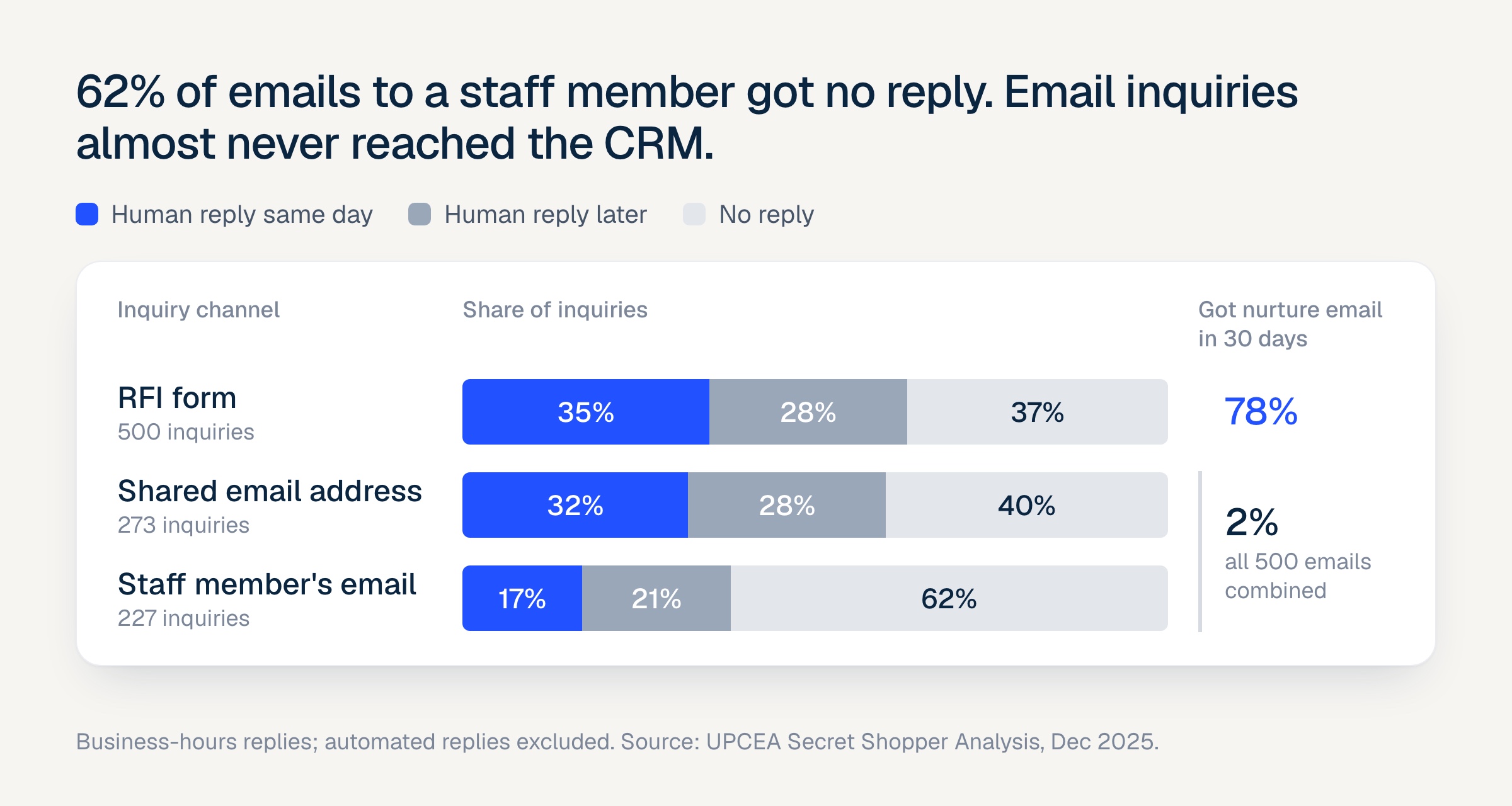
Results split sharply by channel. RFI forms improved slightly, from 39% unanswered in 2023 to 37%. Shared inboxes slipped from 37% to 40%. Email to an individual staff member got much worse, from 47% unanswered to 62%, and its median reply nearly doubled from 2 hours 36 minutes to 4 hours 56 minutes.
UPCEA's read is that most institutions still reply within a few hours, while "a small but growing group of very delayed responses is inflating the averages." That group is where your leads go to die.
Why do so many college inquiries never get a response?
It is rarely laziness. The study points at the plumbing: business-hours staffing, inboxes as the system of record, and single-channel follow-up.
Inquiries land in one person's inbox
When the program page lists a coordinator's email, that inbox becomes the funnel. The coordinator goes on vacation, changes roles, or is also teaching. UPCEA put it plainly: "Relying on a single person's inbox can quickly create bottlenecks." Sixty-two percent of those emails went unanswered.
Email inquiries never reach the CRM
This is the finding that should worry an enrollment VP most. 78% of RFI inquiries received promotional or nurture emails within 30 days. Only 2% of email inquiries did. Of 500 email inquiries, just 10 received any follow-up email in that window. UPCEA concludes that "nearly all of these inquiries were not entered into institutional CRMs." These students exist nowhere in your funnel reporting, so nobody knows they were lost.
The office closes at 5
Adult learners research programs after work and after the kids are in bed. EAB's data on enrolled students using its student-facing AI assistant shows the pattern: 75% of queries arrived outside business hours, 43% between 6 p.m. and 11 p.m. Those are current students, but prospective adult learners likely keep the same hours. A business-hours team can't meet them there, and the study's clock doesn't even count the nights and weekends.
Follow-up runs on one channel
Of RFIs where the shopper left a phone number, only 24% got a phone call and 29% got a text within 30 days. Email carried nearly everything. RNL's 2024 survey of online program leaders shows the same gap from the other side. More than 70% of online programs use texting somewhere in their communications, but only 5% use it to respond to initial inquiries, while nearly 80% of online students say they want to interact with programs via text. For a working adult who checks personal email once a day, an email-only first response can mean the first useful message is read two days after the inquiry.
The form doesn't invite a conversation
75% of RFI forms had no box for a question. Forms with one had fewer unanswered inquiries (32% vs. 39%). 19% of forms required a mailing address, which UPCEA flags as a likely reason students abandon them. Some forms failed outright: one returned "Access Denied" after submission, and another would not accept a 2026 start date.
Here is how those failures map to fixes.
| Inquiry channel | UPCEA finding | Fix |
|---|---|---|
| Email to an individual staff member | 62% unanswered (47% in 2023); median reply 4h56m | Replace personal addresses on program pages with a shared, CRM-tracked queue. Auto-create a lead record for every inbound email. |
| Centralized email address | 40% unanswered (37% in 2023); average reply 20h32m | Assign an owner and a response SLA. Measure time to first human reply weekly. |
| Email inquiries in general | 2% entered a nurture sequence; 10 of 500 got any follow-up | Treat an email like an RFI. Same record, same sequence, same advisor routing. |
| RFI form | 37% unanswered (39% in 2023); average reply 9h33m | Two-way text and email within minutes, a call attempt in the first hour, and an advisor booking as the goal. |
| RFI without a question box | 75% of forms; 39% unanswered vs. 32% with one | Add an optional "What do you want to know?" field and answer that question first. |
| Phone number on the RFI | 24% got a call, 29% got a text in 30 days | Use the number. Text first so the student recognizes you, then call. |
| Form fields | 19% required a mailing address; one form blocked submissions | Cut required fields to name, email, phone, program of interest, start term. Test every form monthly. |
How fast should you respond to an RFI for an online program?
Respond within five minutes, every hour of the week, with something personal that asks a question back. That standard sounds aggressive until you look at what students say they expect.
RNL's 2024 Online Student Recruitment Report asked online students, "How soon after submitting an inquiry do you expect to hear from the program?"
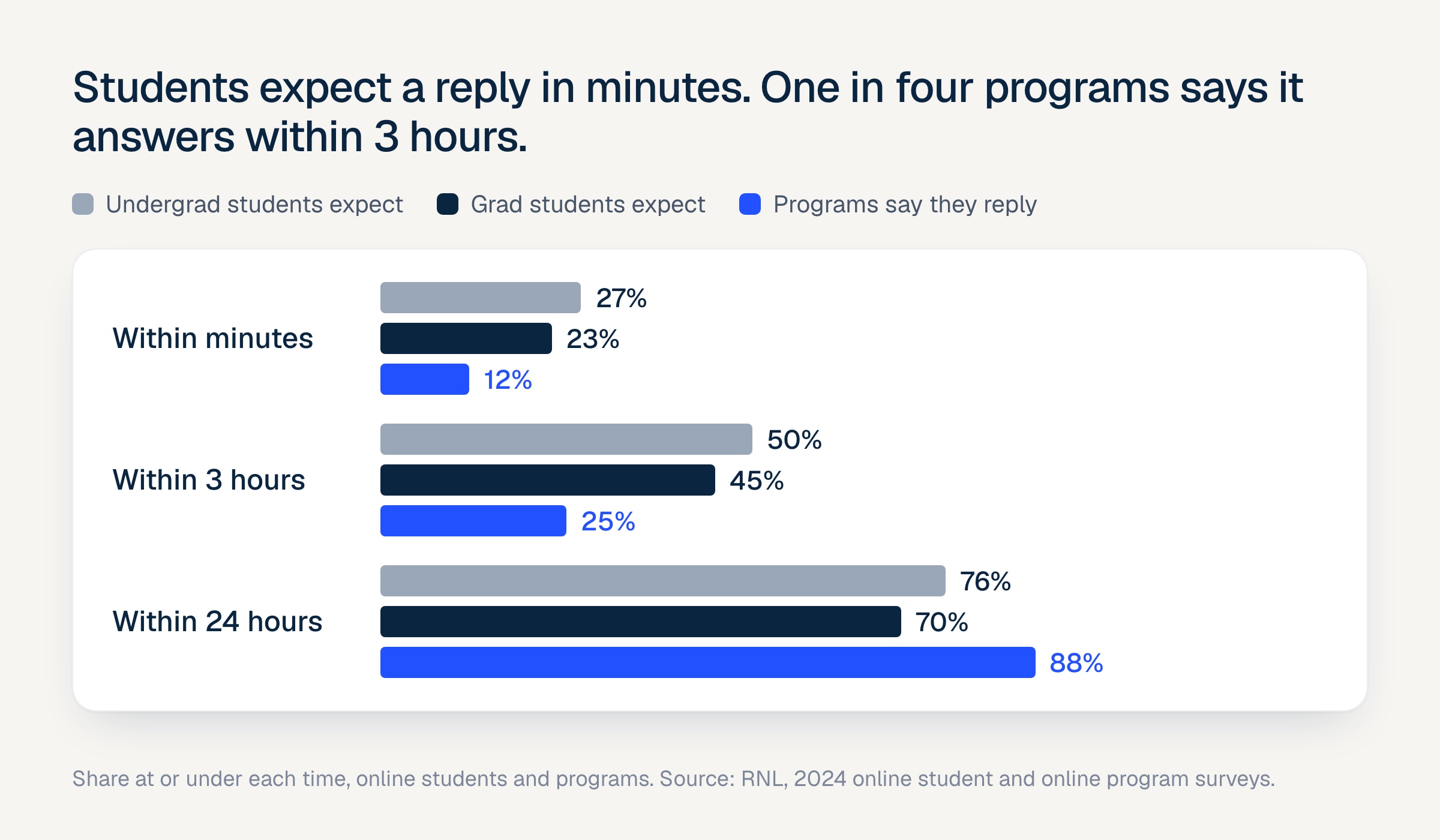
Undergraduate online students. 27% said immediately and 23% said within three hours. About three in four expect a reply within 24 hours.
Graduate online students. 23% said immediately and 22% said within three hours. About 70% expect a reply within 24 hours.
Now compare that with what programs say they do. In RNL's 2024 survey of online program leaders, 12% said they respond to initial inquiries within minutes, 17% within an hour, and 25% within three hours. Half of undergraduate online students expect a reply within three hours. One program in four says it delivers that.
Even those numbers are probably generous. In the same survey, about half of programs said they reply the same business day and only 12% said they take more than 24 hours. UPCEA's shoppers, sending real inquiries a year later, found only 30% got a same-day reply and 44% got none. Self-reported speed and measured speed are different numbers. That's why the audit later in this post matters.
Slow replies also send a message. In RNL's student survey, 44% of graduate online students and 45% of undergraduate online students said a slower-than-expected response signals "that I am not a priority/important to that program/school." Over 40% in both groups read it as a sign the program lacks adequate support services. For an online program selling flexibility and support, that's the wrong first impression.
Practical targets by channel:
RFI form, webchat, or inbound text. A personal reply in under five minutes, 24/7.
Inbound email. A reply that answers the actual question within an hour, plus a CRM record.
Inbound call or voicemail. Answer live, or call back within 15 minutes during staffed hours, with a text if you miss them.
First live advisor conversation. Same day if the student is available, booked for the next business day if not.
An autoresponder doesn't meet any of these. UPCEA didn't count automated replies, and students don't either.
What seconds look like next to 14 hours
In Apten's data from 14 schools over the last 90 days (July to October 2026), the first reply to a new inquiry went out in 7 seconds at the median school. 98% of new inquiries got a reply within a minute. Compare that with UPCEA's average of 14 hours and 23 minutes of business time. The two figures don't measure the same thing. UPCEA counted only replies from a person, and Apten's first reply comes from an AI agent that can answer the student's question. The student still gets a real answer that evening instead of two working days later.
The after-hours numbers matter more. At the median school in that group, 61% of inquiries arrived outside weekday 9-to-5. Schools that let Apten respond around the clock reached about 98% of those after-hours inquiries within 5 minutes. Schools that hold messages until business hours reached almost none in that window. Same software, different setting. If most of your students inquire after the office closes, a business-hours rule means most of them wait overnight.
Do online students enroll at the first school that responds?
Many say they will. In RNL's 2024 online student survey, 17% of online students said they would definitely enroll in the first program to respond to their inquiry, 32% very likely, and 27% likely. That is 76% leaning toward the first responder. Only 15% said no.
Graduate students say something similar. RNL's 2023 graduate student research, summarized in its 2023 Graduate Marketing and Recruitment Practices report, found that "more than 60 percent of graduate students will likely or definitely enroll in the program that responds to their inquiry first." The same research found that "two-thirds of graduate students expect a response to their initial inquiry and other follow-up questions within 24 hours," and 20% expect a personalized email, text, or call within minutes.
Two caveats. These are stated intentions, not tracked enrollments. And students who say "likely" still weigh price, accreditation, and program fit. But online learners usually inquire at several programs in the same evening. The first program to start a useful conversation gets to answer the questions that decide the rest. You may have seen a "78% enroll with the first responder" figure cited in higher ed. We couldn't trace it to a primary source, so we use RNL's numbers.
How do you answer prospective students after hours and on weekends?
You need coverage that can do more than acknowledge receipt. A student who submits an RFI at 9:40 p.m. on a Sunday usually has a question: Can I transfer credits? Is there a cohort starting in January? What does it cost after employer reimbursement? If the first reply can't answer, the student keeps shopping.
Workable options, from least to most coverage:
Staggered advisor shifts. Push one or two enrollment coaches to an evening shift and one to Saturday. This covers part of the gap and costs headcount.
An outsourced call center. More hours, but handoffs back to your team lose context.
A conversational AI agent on every channel. It answers the RFI by text and email within seconds, replies to follow-up questions from your approved program content, books an info session or advisor call, and logs the conversation to the CRM. Advisors start Monday with a summary instead of a cold list. This is the approach we covered in AI enrollment agents for higher education.
Whatever you choose, keep two rules. Replying to an inquiry the student just submitted is different from cold outbound, but outbound follow-ups should still respect quiet hours in the student's time zone. And texting requires consent captured on your RFI form, which is the institution's responsibility. Check your consent language with counsel.
What does a good first 72 hours look like?
The goal of the first three days is a booked conversation with an advisor, an info session registration, or an app start. Each touch should reference what the student already said, on whatever channel they said it.
| When | Touch | Purpose |
|---|---|---|
| 0 to 5 minutes | Personal text plus email | Confirm the program of interest, answer the form question, ask one qualifying question. |
| Within 1 hour (staffed time) | Call from a number the student just got a text from | Live conversation or warm transfer to an advisor. Text if no answer. |
| Same evening | Text reply handling, webchat | Answer questions as they come. Offer advisor times. |
| Day 2 | Email with program specifics, then a text | Cost, start dates, transfer credit, checklist items like transcripts and app fee. |
| Day 2 or 3 | Second call attempt | Advisor conversation or info session booking. |
| Day 3 | Short text with one clear next step | Book, apply, or tell us it isn't the right time. |
After 72 hours, students who haven't engaged move into a slower nurture track, not a dead list. Aged leads and closed-lost inquiries are worth a re-engagement pass each term, especially for programs with multiple start dates.
The sequence only works if every channel shares one record. When the day-2 email repeats what the text answered at 10 p.m., the student notices. We wrote more about why that breaks in omnichannel AI in 2026.
How do you secret-shop your own funnel in an afternoon?
You don't need a vendor to find your leaks. Pick three programs, ideally one high-volume, one graduate, and one certificate. Then:
List every inquiry path. Each RFI form, each email address on a program page, the central admissions inbox, webchat, the main phone line, and any third-party lead sources.
Create two or three test personas. Use real inboxes and phone numbers your team doesn't recognize. Give each a realistic adult-learner question, like transfer credit or employer tuition benefits.
Submit through every path. Send at least two after 5 p.m. and one on a Saturday. Fill out each form on a phone as well as a laptop.
Check the forms themselves. Count required fields. Look for mailing address or date of birth requirements, expired start terms, and errors on submit.
Log the clock. Record time to first automated reply, time to first human reply, and which channel it came on.
Check the CRM. Did every test inquiry create a record? Was the program of interest right? Did email inquiries enter the same sequence as RFIs?
Count the first 72 hours. How many touches arrived, on how many channels, and did any of them answer your question?
Reply like a real student. Text back a follow-up question at 9 p.m. See whether anyone, or anything, answers before morning.
Score it against UPCEA. If any path left a test unanswered, you're in the 44%. If your median human reply is over three hours, about half of online students expected to hear from you sooner.
Setup takes an afternoon and results come in over three days. The fix for an orphaned staff inbox is often a ten-minute website edit.
Where Apten fits
Apten builds AI agents for admissions and enrollment teams at online and career-focused institutions. The agent responds to every RFI within seconds, at any hour, by text and email, and keeps the same conversation going across SMS, voice, email, and webchat. It remembers what the student asked on each channel, so the day-2 call picks up where the 10 p.m. text left off.
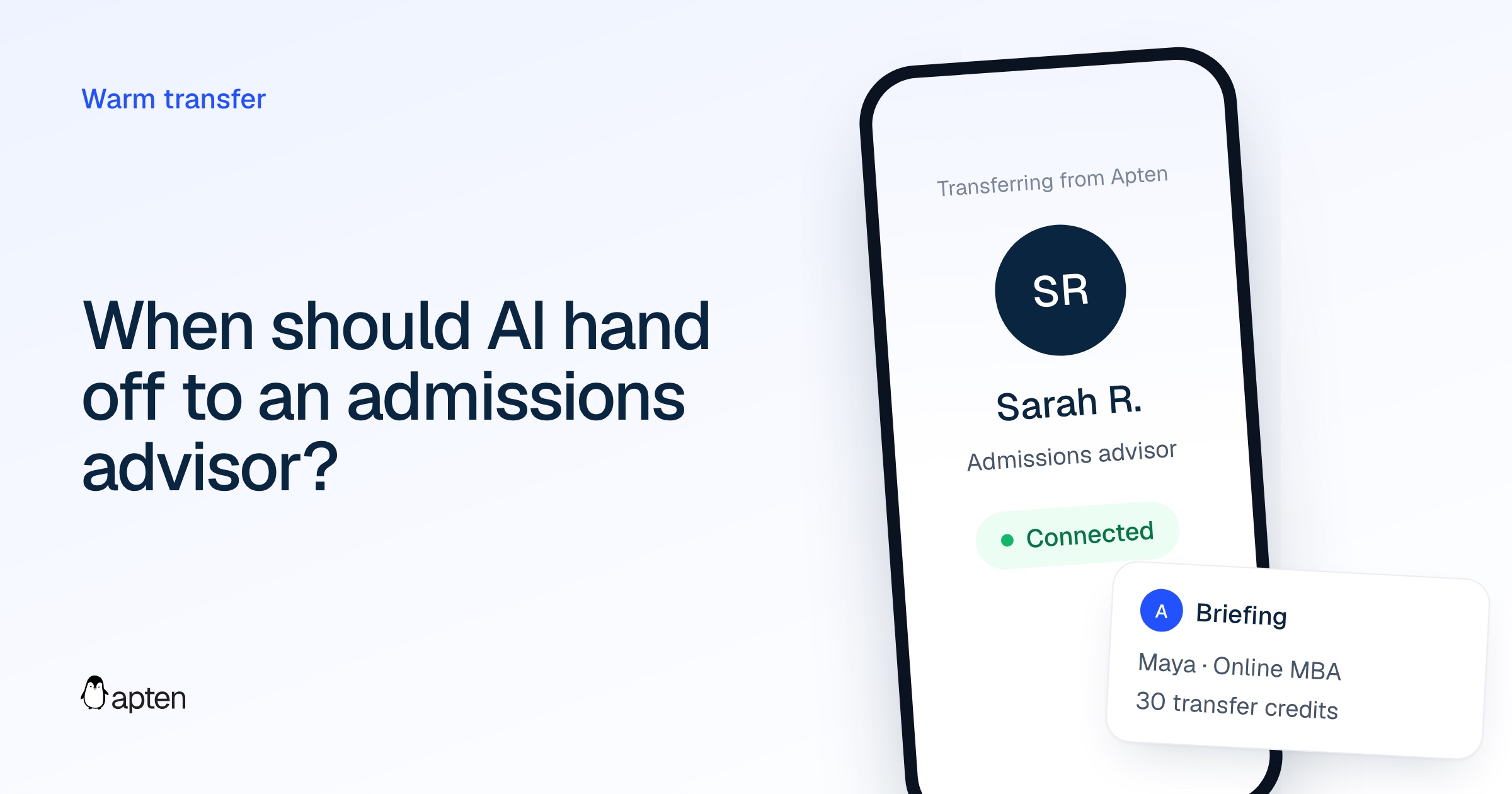
When a student is ready, the agent can move a text conversation to a live call and warm-transfer to an admissions advisor with a summary of the program of interest, start term, and open questions. It books info sessions and advisor appointments and syncs activity to Salesforce or Microsoft Dynamics, so after-hours inquiries show up in your funnel reporting.
Your team sets the guardrails, and the agent checks each message against them before it sends. Quiet hours and opt-out handling are built in, and opt-outs sync back to your CRM by webhook. Apten is SOC 2 Type II with encryption at rest and in transit. Consent capture stays with your RFI forms and your team.
The takeaway
The inquiry problem is getting worse even as CRMs spread. Nearly half of inquiries go unanswered, and email to individual staff is the biggest leak. Online learners expect a reply within hours, often minutes. Close the orphaned inboxes, cover nights and weekends, and run a multichannel first 72 hours that ends with an advisor conversation.
Book a 20-minute demo to see how Apten answers every inquiry in seconds
Sources
UPCEA: Enrollment Process Review, Secret Shopper Analysis (December 2025)
RNL: 2024 Online Program Marketing and Recruitment Practices
EAB: What Are Students Asking University Chatbots? (October 2025)
Apten platform data, 14 schools with 500+ real-time inquiries, Jul 28–Oct 25 2026, bulk imports excluded