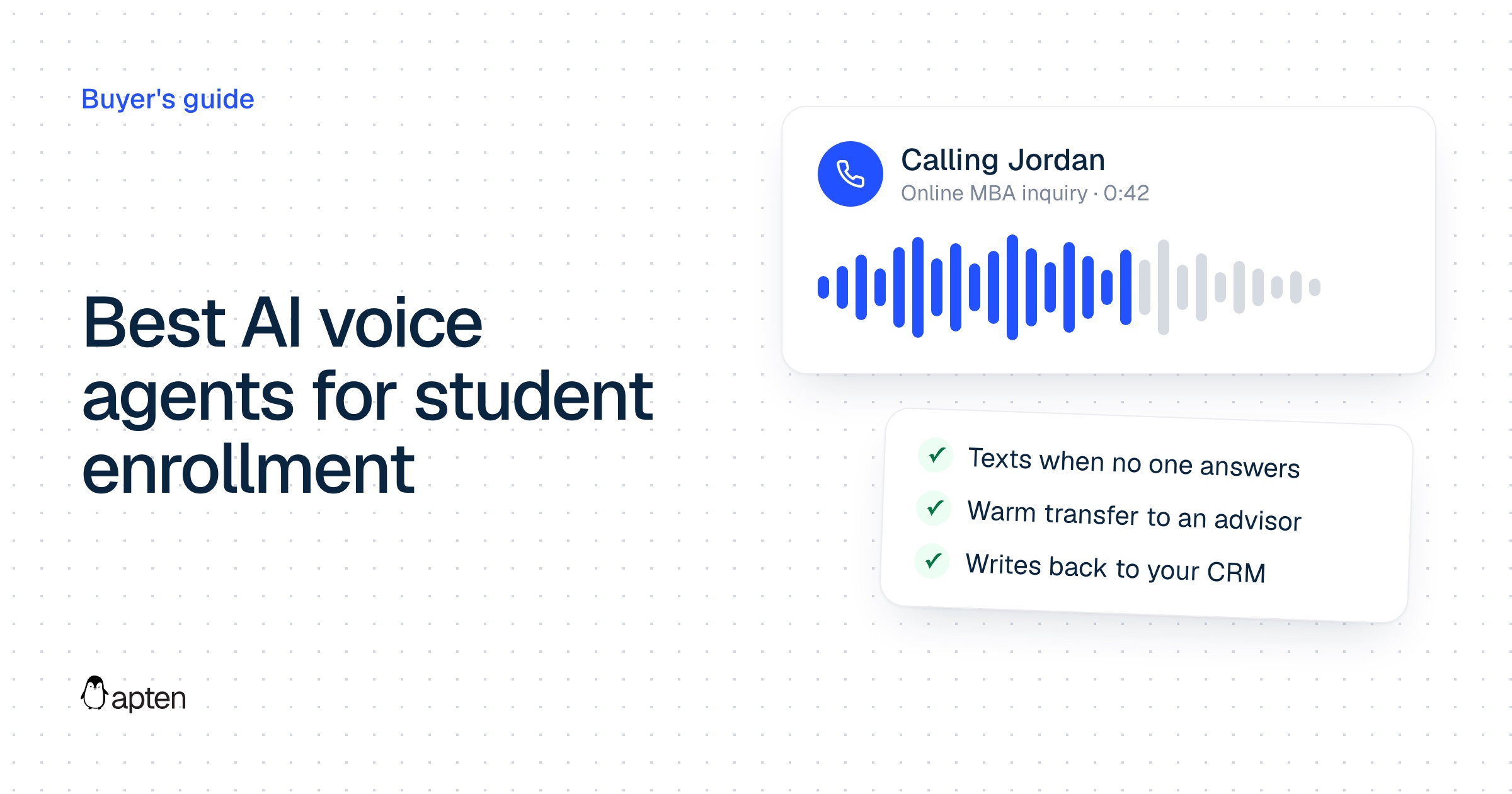
The best AI voice agent for student enrollment is the one that handles the call that doesn't connect. For online and adult enrollment teams, that means it texts the student after a missed call, can move a text conversation to a live call, warm-transfers to an advisor with a summary, writes the outcome back to your CRM, and respects quiet hours and opt-outs. Enrollment-specific agents ship most of that already built. Voice platforms like Retell, Bland and Vapi give you better parts and leave the enrollment workflow for you to build.
Most "best AI voice agents for student enrollment" lists you'll find were written by voice vendors, and each one puts its author first. Retell's list ranks Retell #1. Bland's 14-vendor list ranks Bland #1. CloudTalk's 11-vendor list ranks CloudTalk "best overall." That's normal for vendor content, and some of those lists are useful. But they score things a voice vendor is good at, like natural conversation and build flexibility, and say little about what happens after an unanswered call to a 34-year-old working nurse at 6:40 p.m.
This list is for enrollment buyers. We make one of the products on it, so it lays out criteria and evidence, not a ranking.
Why does voice need more than a good voice?
Because the phone is a hard channel for reaching prospective students. In UPCEA's December 2025 secret shopper study, shoppers left a phone number on 49% of RFIs. Only 24% of those got even one phone call from the institution within 30 days. 29% got a text. Institutions aren't calling much, and when they do, many adult learners screen calls from numbers they don't recognize.
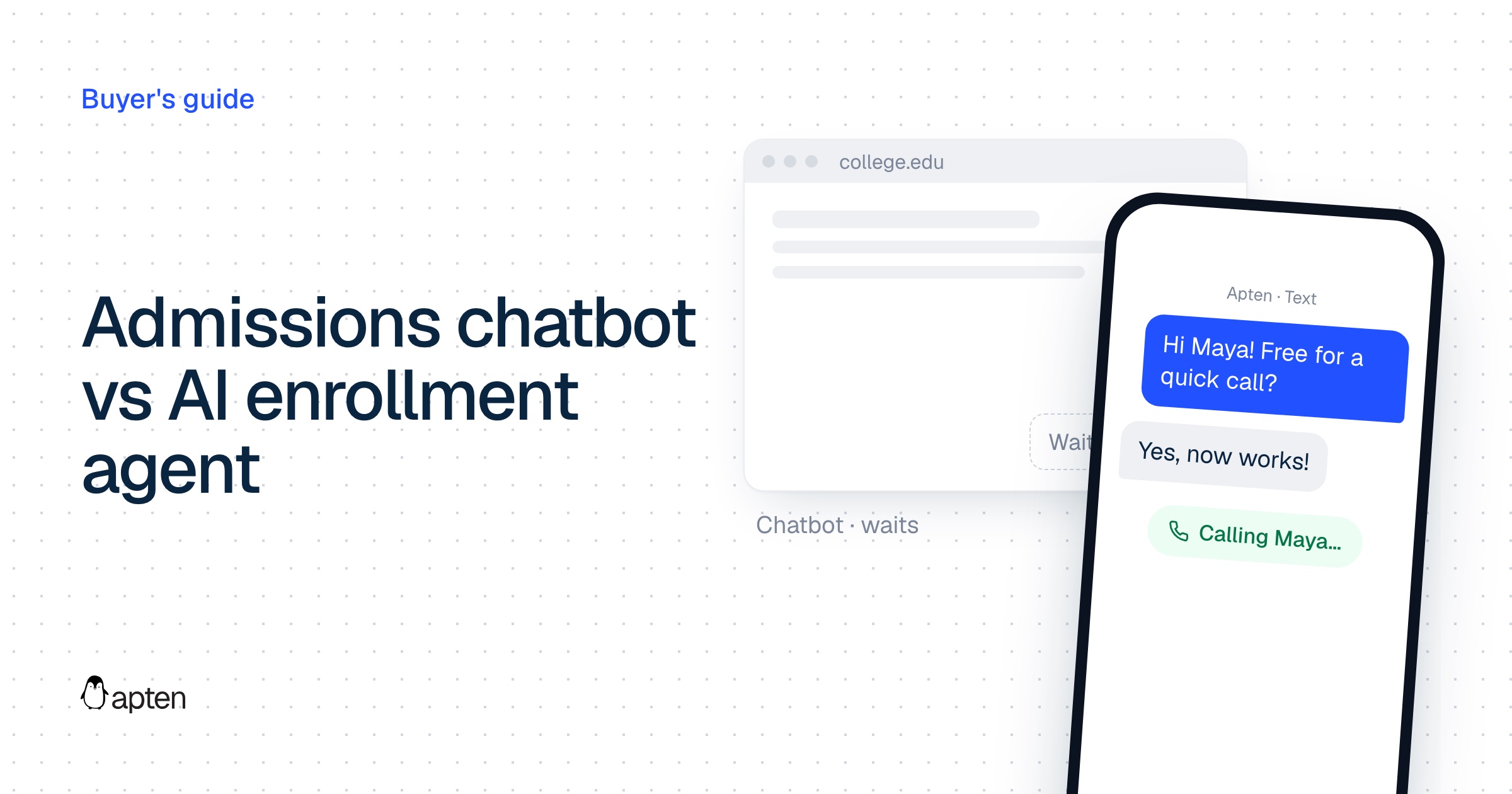
So a voice agent that only calls has a ceiling. The calls that matter most are the second and third touches, after a voicemail or after a student texts back "can you call me after 7?" That's where voice tools differ the most, and where vendor-written lists say the least. If you're still deciding between a chatbot, a texting tool and an agent, start with admissions chatbot vs AI agent. This post assumes you've decided you want voice.
What features should you look for in an AI phone agent platform for education enrollment teams?
These are the six criteria we used. Each comes with a test you can run in a demo.
SMS fallback and text-to-call. When a call goes unanswered, does the agent text the student on its own, using what it knows about the student? And when a student replies by text, can the same agent call them right away or at a time they pick? Test it by letting a demo call ring out, then replying to the text with "call me now."
Voicemail handling. Does the system detect an answering machine and change course, or does it talk at the greeting for 40 seconds? Ask what it does next after reaching voicemail. Does it leave a message, hang up, send a text or reschedule?
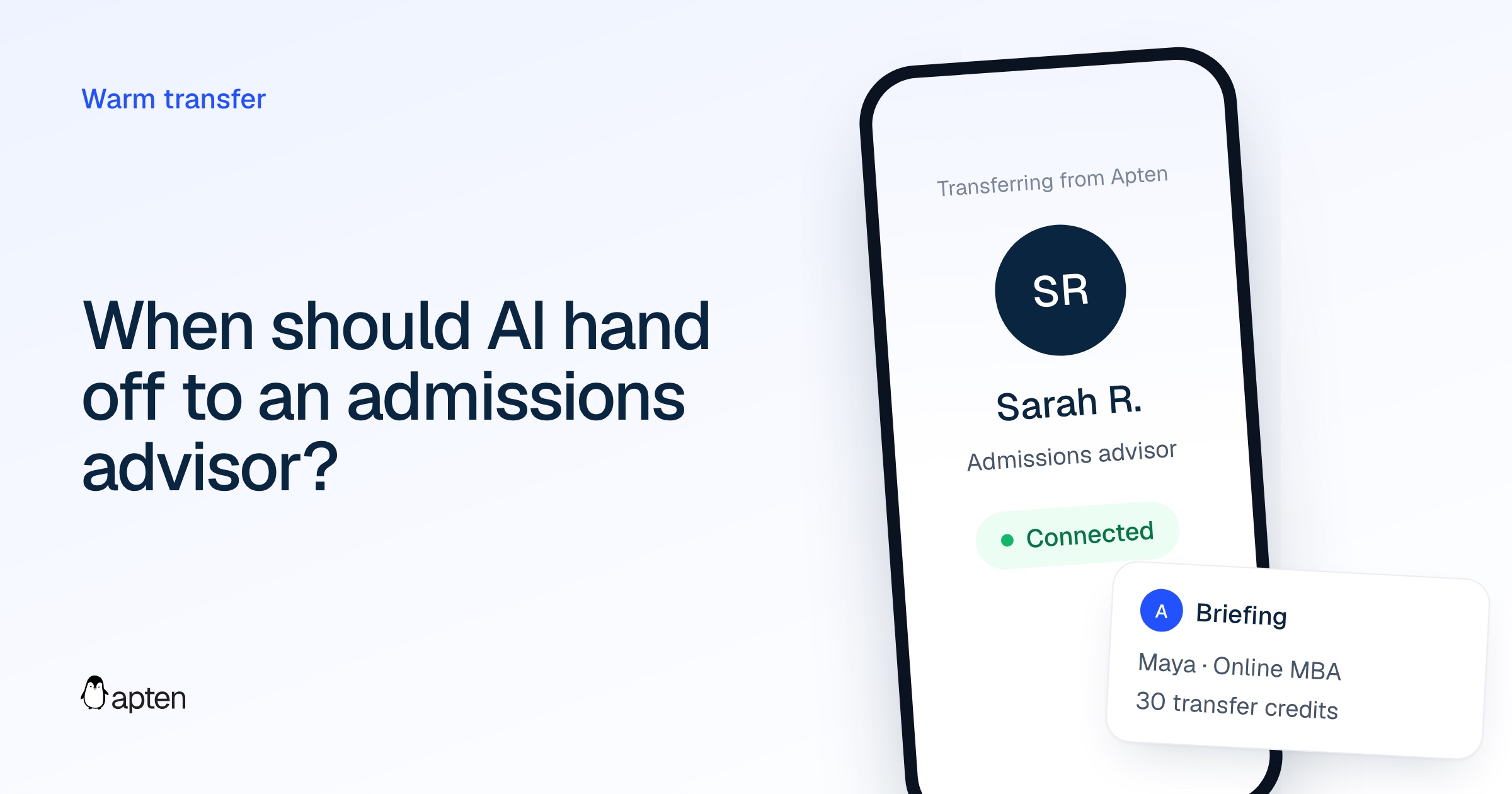
Warm transfer to advisors. A cold transfer drops the student into a queue. A warm transfer briefs the advisor first. Ask what the advisor sees and what happens when nobody picks up, because in a busy call center that happens all the time. Our guide to warm transfers covers what a good handoff looks like.
CRM write-back. Ask which CRMs are supported natively (Salesforce, Dynamics, Slate, Element451, HubSpot) and exactly which fields get updated after a call. "Integrates with your CRM" can mean anything from full activity logging to a webhook you wire up yourself.
Compliance controls. Online programs enroll nationally, so quiet hours have to follow the student's time zone, not your office's. Opt-outs should stop calls as well as texts, whichever channel the student used to say stop. Ask who handles consent capture and Do Not Call scrubbing. In most setups that's you.
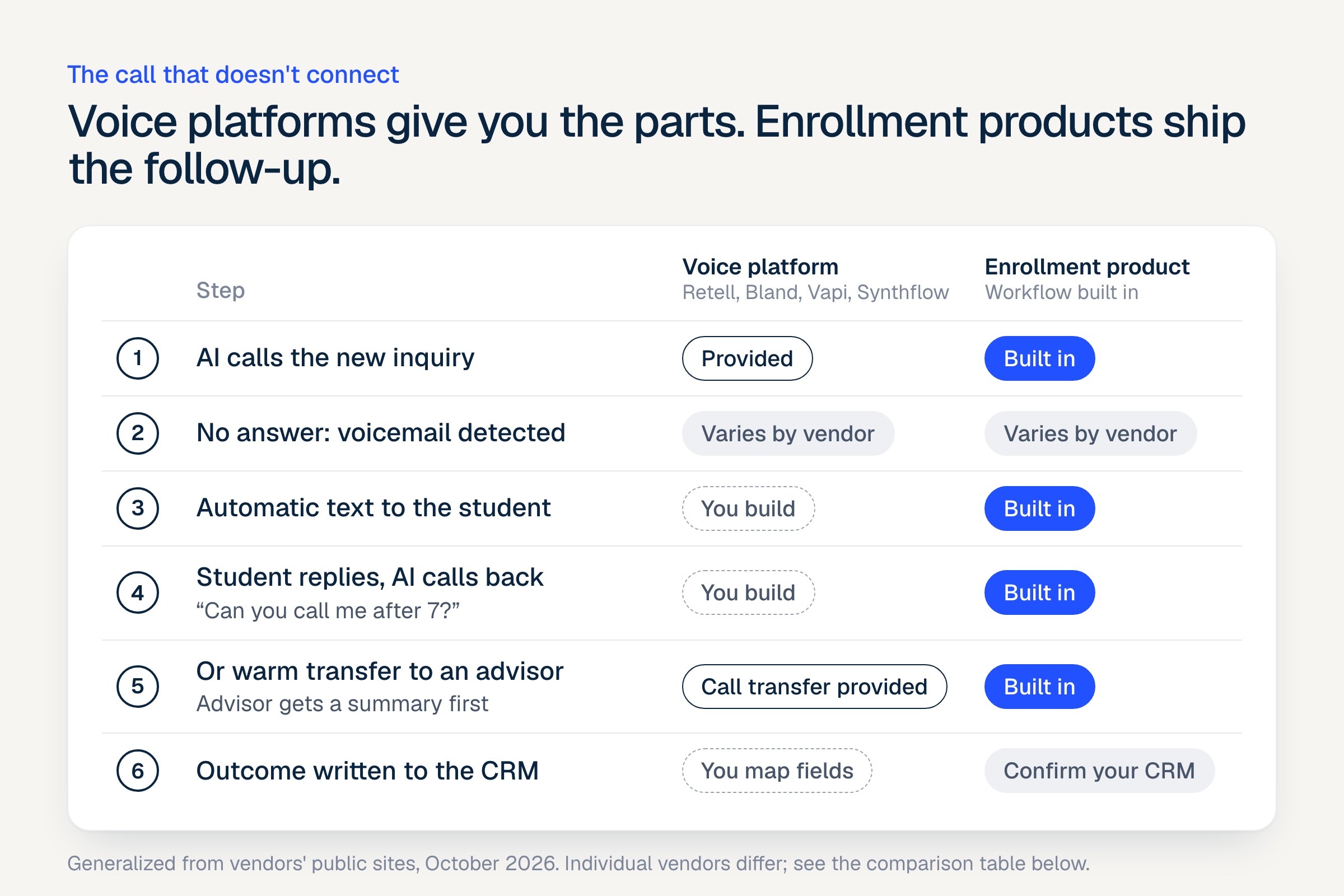
Enrollment product or voice API. Is the enrollment workflow built in, with inquiry follow-up cadences, program questions, booking and handoff rules? Or do you get a builder and an API? Neither is wrong. They need different teams.
Voice quality and latency still matter. But every vendor on this list sounds good in a demo, so they rarely decide the purchase.
Should you buy an enrollment product or build on a voice platform?
This is the biggest split on the list, and it matters more than any single feature.
Voice platforms (Retell AI, Bland, Vapi, Synthflow) sell infrastructure and builders. You get speech recognition, a language model, a synthetic voice, telephony, call transfer and an API. They're usually cheaper per minute and give you more control over the conversation. You also own the build. Someone writes the prompts, maps CRM fields, decides when to text versus call, handles opt-outs across channels and keeps it all working when your programs change. A team with engineers, or an agency partner, can build something good. An admissions office without either will struggle.
Enrollment products (Apten, Element451, CollegeVine, Regal, Uptail) come with the admissions workflow built in, and most cover text, email or chat as well as voice. You give up some low-level control and usually pay more than raw per-minute rates. In return, the cross-channel follow-up and handoff logic already exist.
CloudTalk sits in between. It's call center software for phone-heavy teams that has added AI voice agents.
Which AI voice agents are enrollment teams evaluating in 2026?
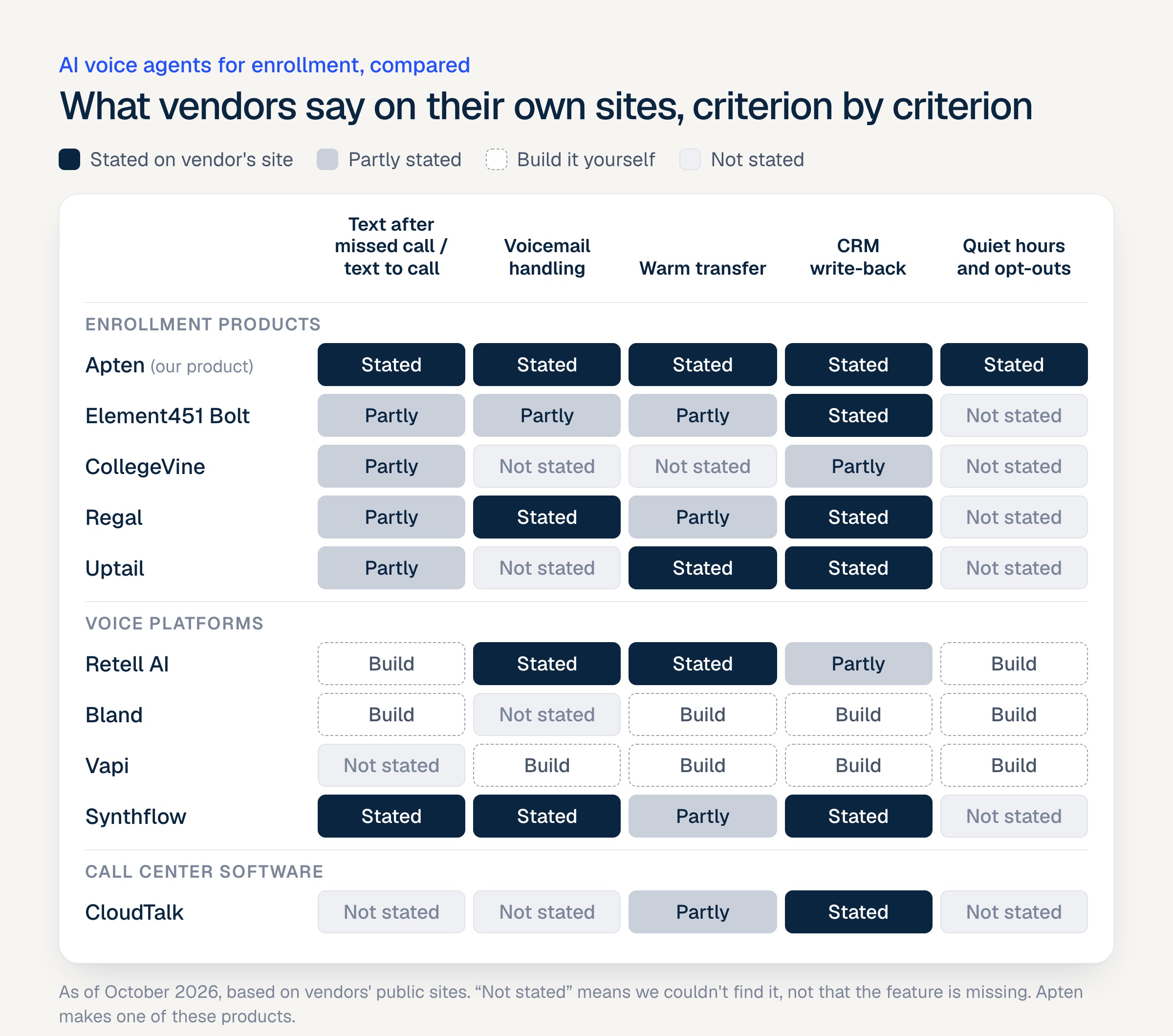
Each description below comes from the vendor's own website or help center as of October 2026. Products change fast, so confirm anything important in a demo. "Not stated" means we couldn't find it on the vendor's site. It doesn't mean the feature is missing.
Enrollment-focused products
Apten. A multichannel AI enrollment agent for online programs and large enrollment teams. One agent covers SMS, voice, email and webchat with one conversation record. Missed calls trigger an automatic text, text conversations can turn into live calls, and warm transfers include a summary. More detail is in the Apten section below.
Element451 (Bolt agents). An AI-native higher ed CRM. Its help center says Bolt agents answer inbound calls on assigned numbers, place outbound calls one at a time or at scale through Bolt Jobs, and can transfer a caller to a staff number. Its inbound-call playbook says agents can send follow-up information by SMS or email. The Bolt agents voice article is dated August 2026 and notes that calls placed before September 2026 may not show an outcome, so the feature is recent. Element says the institution is responsible for complying with calling and recording laws. This is the strongest fit for schools already on Element451's CRM.
CollegeVine (AI Recruiter). Built only for higher ed. CollegeVine says AI Recruiter handles inbound inquiries over phone, email, text and chat, and can go proactively outbound. Its site doesn't describe voicemail handling, transfer mechanics or which CRMs it supports, so ask about all three.
Regal. An AI agent platform with a dedicated education practice. Regal's education page covers inbound and outbound AI calls and two-way SMS, and it lists Salesforce, Microsoft Dynamics and HubSpot integrations and TCPA among its compliance frameworks. Its case study with Aprende, an online vocational institute, describes the agent qualifying callers before passing them to human advisors, plus real-time voicemail detection. Regal is strong for phone-centric enrollment call centers. Its education page doesn't describe quiet-hours settings.
Uptail. An admissions-focused agent platform with customers including UNIR, Ironhack and Wall Street English, and pricing in euros (Growth plan at €1,850 a month). Channels listed are WhatsApp, Messenger, Instagram, phone, chat and SMS, with "warm handoffs to admissions reps" on the phone channel and Salesforce and HubSpot integrations. Its product page doesn't spell out how far AI voice calls go, so confirm it. It's a good fit for international or WhatsApp-heavy programs.
Voice platforms you build on
Retell AI. A platform for building, testing and deploying voice agents, with a no-code studio and full APIs. Retell's site lists SMS, call transfer, "agentic human handoffs" that brief a human before connecting, CRM write-back (HubSpot and GoHighLevel named), and outbound campaigns that handle voicemail. Pay-as-you-go pricing is $0.07 to $0.31 per minute depending on model and voice. It's among the strongest for voice quality and control. You build the enrollment logic.
Bland. An enterprise voice AI platform. Agents run on phone, SMS and web and connect to other systems through integrations you configure. Bland lists $0.12 to $0.14 per minute of talk time, a $299 monthly fee on its Build plan, and audited SOC 2 Type II reports. It's built for high-volume outbound at enterprise scale.
Vapi. An API-first voice agent platform for developers. Hosting is $0.05 a minute, with models, voices and telephony billed at provider cost. It's the most flexible option and the most engineering-heavy. Its homepage doesn't mention SMS, so plan to build text follow-up separately.
Synthflow. A visual flow builder for voice agents with built-in voicemail detection, SMS follow-ups, human handoff and HubSpot and Salesforce integrations. Its site lists no education customers, so you'd be the one adapting it to admissions.
Call center software with AI voice
CloudTalk. Cloud call center software with an AI voice agent for inbound and outbound enrollment calls. CloudTalk says it connects to more than 35 CRM and SIS platforms, and plans start at $25 per user per month billed annually. CloudTalk notes that per-minute AI pricing adds up at high volume, so ask how AI minutes are billed. It's a good fit if you already run a human call center and want AI on the same phone system. CloudTalk describes itself as voice-first, so check how much text follow-up you get.
Often on these lists, but not voice agents
Mainstay lists SMS, live chat, web chat and social media, with no voice channel. Ivy & Ocelot covers chat, text, email, WhatsApp and social, and lists telephony without describing AI voice calls. EAB's offering here is an AI Chat Agent. All three can be good products. They just don't answer the question "which AI should call our students?" For texting-first alternatives, see our comparison of Mainstay alternatives for online enrollment.
How do the AI voice agents compare?
"Build" means the platform gives you the pieces and you configure the behavior. "Not stated" means the vendor's site didn't say either way.
| Vendor | Type | Text after missed call / text to call | Voicemail handling | Warm transfer | CRM write-back | Quiet hours and opt-outs |
|---|---|---|---|---|---|---|
| Apten | Enrollment agent (SMS, voice, email, webchat) | Automatic text after missed call; text can start a call now or schedule one | Detects voicemail, then follows up by text | From voice, SMS and webchat, with summary and optional fallback number | Salesforce, Dynamics, HubSpot, Close (mapped fields) | Quiet hours in lead's time zone; opt-outs per channel |
| Element451 Bolt | Higher ed CRM with AI agents | SMS and email follow-ups; outbound calls via Bolt Jobs | Logs voicemail outcomes; detection not stated | Transfer to an assigned staff number | Native, inside Element451 | Not stated; institution owns calling-law compliance |
| CollegeVine | Higher ed AI recruiter | Phone, text, email and chat; mechanics not stated | Not stated | Not stated | Uses CRM data; CRMs not named | Not stated |
| Regal | AI agent platform with education practice | Two-way SMS and AI calls | Voicemail detection (case study) | Hands qualified callers to advisors | Salesforce, Dynamics, HubSpot | TCPA listed; quiet hours not stated |
| Uptail | Admissions agent, WhatsApp-first | SMS, WhatsApp, phone listed | Not stated | Listed on phone channel | Salesforce, HubSpot | Not stated |
| Retell AI | Voice platform | SMS available; build | Handled in outbound campaigns | Handoff that briefs a human first | HubSpot named; build others | Build |
| Bland | Voice platform | SMS available; build | Not stated | Call transfer; build | Build | Build |
| Vapi | Developer voice API | Not stated; build | Build | Build | Build | Build |
| Synthflow | No-code voice builder | SMS follow-ups built in | Voicemail detection built in | Human handoff | HubSpot, Salesforce | Not stated |
| CloudTalk | Call center software with AI voice | Voice-first; text not stated | Not stated | Human handoff logic | 35+ CRM and SIS integrations | Not stated |
A "Not stated" isn't a mark against a vendor. It's a question for the demo. Compliance fields are mostly "Not stated" because few voice vendors publish how quiet hours work, which is a reason to ask everyone, including us.
Where are other vendors stronger than an enrollment agent?
A packaged enrollment agent isn't always the right call. Here's where the others win.
If you live in Element451's CRM, Bolt agents sit on your records with no integration project. No outside agent can match that.
If you have engineers and want full control, Retell and Vapi give you lower per-minute costs and access to every part of the call. You can tune latency, voices and models in ways a packaged product won't expose.
If your enrollment model is a phone room, CloudTalk and Regal come from call center software. They're built for human and AI agents working side by side on one phone system.
If your students are on WhatsApp, Uptail treats it as a first-class channel.
If you're on Slate, ask every vendor for a live demo of the Slate sync, not a slide. Native Slate support varies a lot across this list.
How should you weigh these criteria for your team?
Start from how your students actually respond, not from the feature list.
Adult and online learners who screen calls. Put text fallback and text-to-call first. Calls that don't connect are the most common outcome, so what happens next decides most of the results.
A call center of enrollment coaches. Put warm transfer and the "advisor didn't answer" behavior first. A transfer that drops the student is worse than no transfer.
A small team with no engineers. Rule out build-your-own platforms unless a partner will build and maintain it.
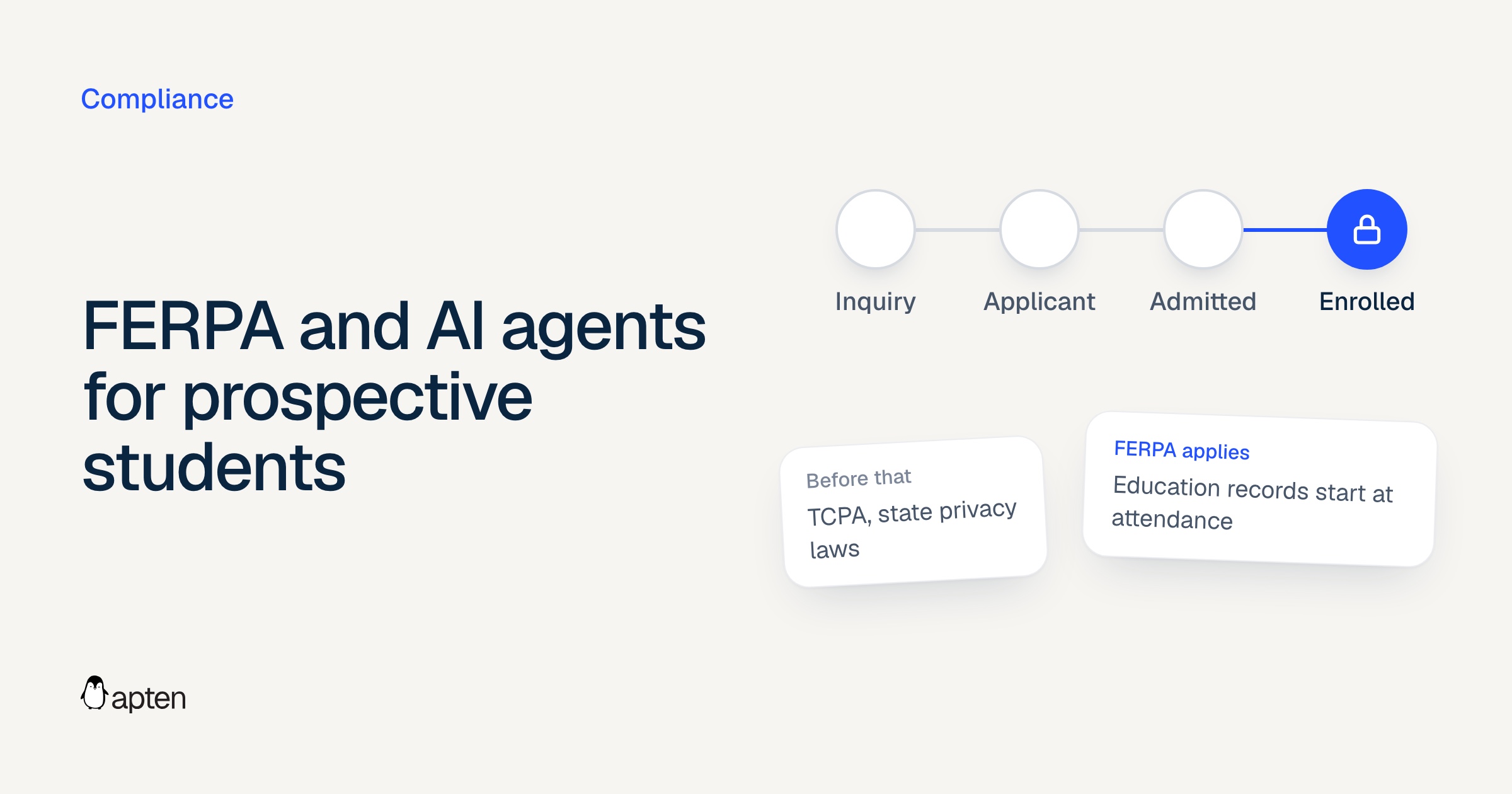
National enrollment across time zones. Put quiet hours and cross-channel opt-outs near the top. The FCC confirmed in February 2024 that AI-generated voices are "artificial" voices under the TCPA, and our TCPA and state law guide covers what that means.
Procurement-led evaluation. Turn the six criteria into written requirements. Our AI enrollment agent RFP questions list has the full set.
This isn't legal advice. Review AI calling and texting consent with your counsel before launch.
How Apten handles voice for enrollment
Apten is a multichannel AI enrollment agent. Voice is one channel of four, and the agent keeps one record across SMS, voice, email and webchat. A student who asked about clinical placements by text gets a call that already knows that.
When a call doesn't connect, Apten detects voicemail and usually sends a text written for that student. It skips the text for landlines and for calls that are already part of a follow-up cadence. In Apten platform data from 10 schools (Jul 28 to Oct 25, 2026), texts sent right after a missed call got a median 40% reply rate within 24 hours. Those students had just been called, often early in the relationship, so don't compare that number with ordinary follow-up texts. It does show what a call is worth when a text follows it. Text also leads back to voice. The agent can call a student mid-conversation or schedule a call, and about 1 in 4 students who reply by SMS move to a live call (median 26% across 14 schools). The median first reply to a new inquiry goes out in 7 seconds.
Warm transfers work from a live call, a text thread or webchat, and the advisor gets a summary. If the advisor doesn't answer, Apten tries your fallback number if you've set one, then texts the student the transfer number and can schedule a callback. Quiet hours follow the lead's time zone. Opt-outs come from STOP keywords plus AI detection of "please stop contacting me," and they're tracked per channel. Apten has completed a SOC 2 Type II audit and encrypts data at rest and in transit.
Apten integrates with Salesforce, Microsoft Dynamics, HubSpot and Close, and writes back the fields you map, such as tags, an AI summary, qualified, replied, transferred and opt-outs. The agent books appointments on Google Calendar or shares your Calendly link. Consent capture and DNC scrubbing stay with your team.
The bottom line
Don't pick a voice agent by how it sounds on a connected call. Pick it by what happens on the calls that don't connect. That means the voicemail, the text that follows, the callback the student asks for, and the advisor who's on another line. Run the ring-out test from the criteria above with every vendor you shortlist, including us.
Book a 20-minute demo and we'll let a call ring out, then show you the text, the callback and the warm transfer, or learn more at apten.ai.
Sources
UPCEA, Enrollment Process Review: Secret Shopper Analysis (December 2025)
FCC, Declaratory Ruling on AI-Generated Voices Under the TCPA, FCC 24-17 (February 2024)
Element451 help center: Advanced Voice Mode for Bolt Agents, Playbook: Handle Inbound Phone Calls, Phone Calling
Enrollment vendors: CollegeVine AI Recruiter, Regal for Education, Regal Aprende case study, Uptail product, Uptail pricing
Voice platforms: Retell AI, Retell AI pricing, Bland pricing, Vapi pricing, Synthflow, CloudTalk for student enrollment
Not voice agents: Mainstay, Gravyty Ivy & Ocelot, EAB AI Chat Agent (all vendor pages accessed October 2026)
Apten platform data, Jul 28 to Oct 25, 2026. Missed-call text replies, 10 schools. SMS-to-call and first-reply time, 14 schools with 500+ real-time inquiries, bulk imports excluded.