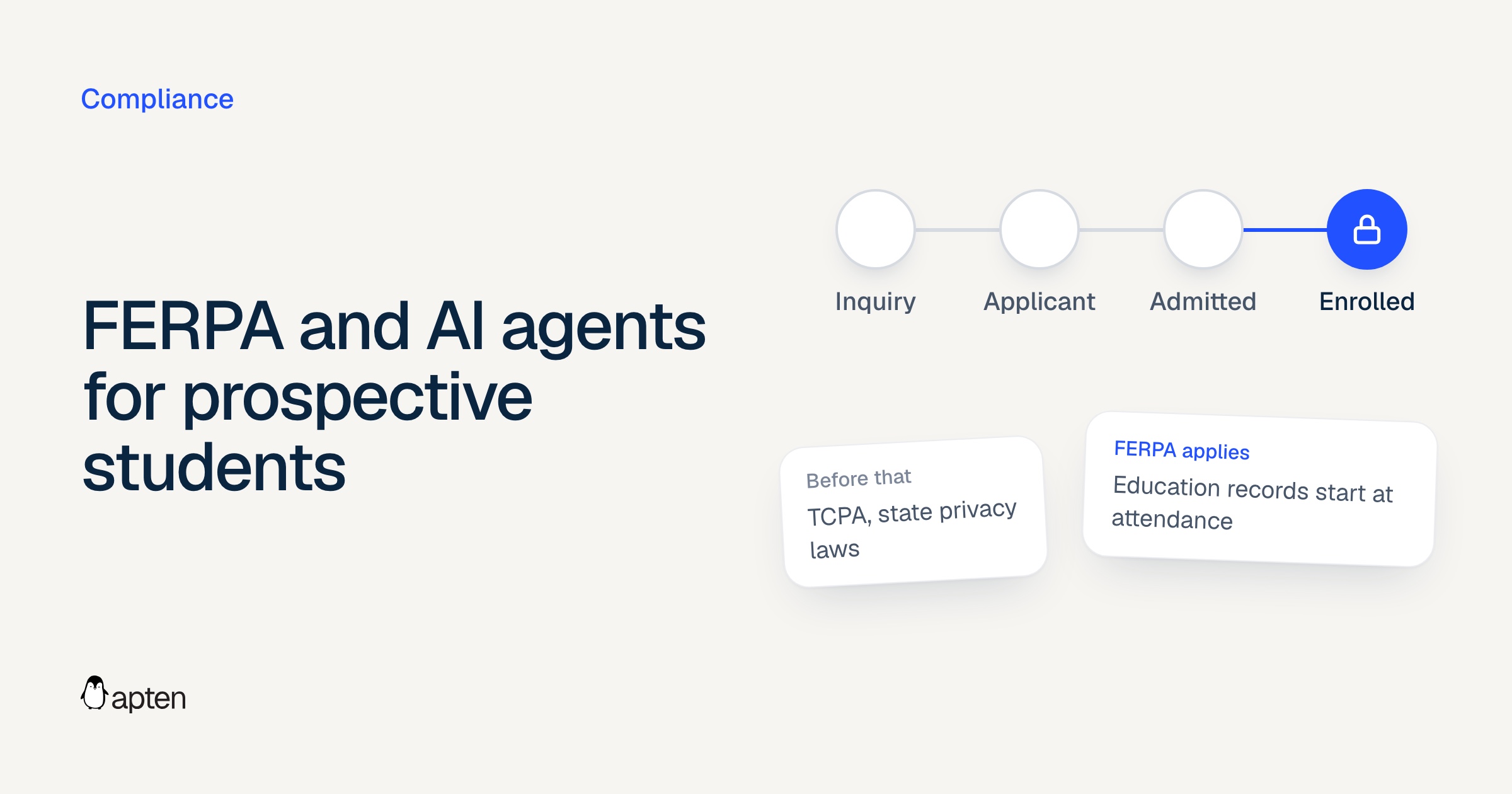
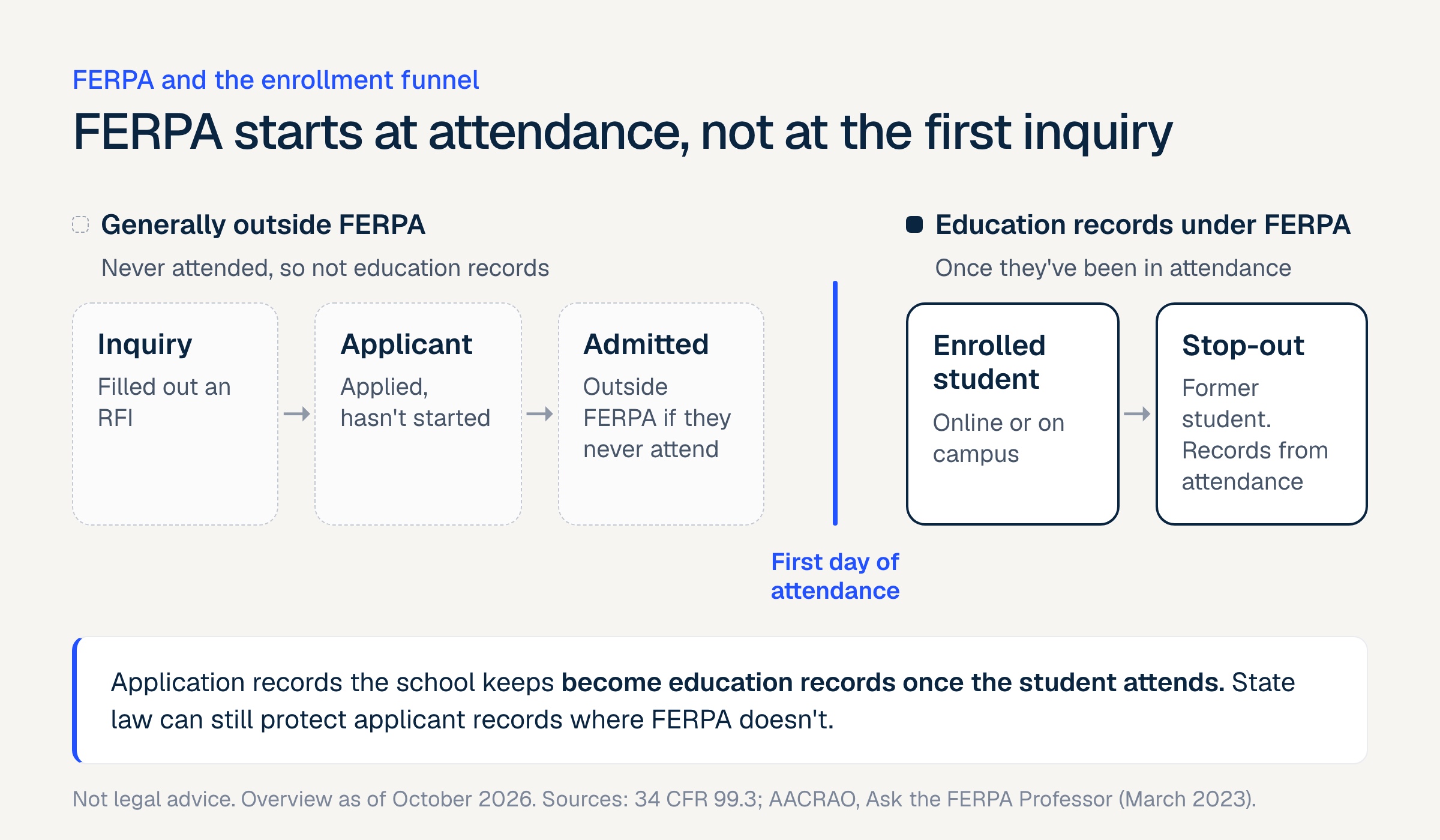
FERPA generally does not apply to prospective students. Under 34 CFR 99.3, FERPA covers education records of "students," meaning people who are or have been in attendance, so records about inquiries and applicants who have never attended are outside it. The line moves when a student enrolls. From then on, an AI phone or text agent that touches that student's records is handling education records, and the vendor has to fit FERPA's school official exception.
That answer matters because many AI vendors sell "FERPA-compliant AI agents" as if FERPA were a badge. It isn't. There's no FERPA certification, and the obligations sit with your institution. What a vendor can do is accept contract terms that let you keep the direct control FERPA requires. This guide covers where the line falls for online programs, what the school official exception asks of a vendor, what belongs in the contract, and which other laws apply to texting and calling prospects.
This is a plain-language overview of the rules as of October 2026, not legal advice. Talk to your general counsel or privacy office before you sign a vendor agreement.
Does FERPA apply to prospective students and applicants?
Mostly no. FERPA's regulations define education records as records "directly related to a student" and "maintained by an educational agency or institution or by a party acting for" it. A "student" is "any individual who is or has been in attendance" at the institution. Someone who filled out an RFI, or applied and never started, hasn't been in attendance.
AACRAO's FERPA Professor column puts it directly: "Records on applicants at an institution do not meet the definition of 'education records' and are thus not subject to FERPA." The same column notes that if the applicant enrolls and the records are kept, "those records then become education records subject to FERPA."
Attendance doesn't require a campus. The regulation counts attendance "by paper correspondence, videoconference, satellite, Internet, or other electronic information and telecommunications technologies." For an online university, a student who starts an online course is in attendance the same as one in a classroom.
Two details catch online programs off guard:
Current students applying to another program. Under 34 CFR 99.5(c), a current or former student who applies to a different component of the same institution has no FERPA rights in that component's application records unless they're accepted and attend. Their existing records from the program they attended are still education records. If your agent can see a student's undergraduate record while recruiting them for a master's program, it's handling education records.
Stop-outs and re-enrollment. A stop-out is a former student. Their grades, enrollment history and account balances from the time they attended are education records. A re-enrollment campaign that pulls that data into an AI conversation needs the same vendor controls as any enrolled-student use.
Where does the FERPA line fall for each type of contact?
Here's how FERPA generally treats the people an admissions AI agent talks to. Edge cases exist, which is why your registrar and counsel should sign off on your own version of this table.
| Who the agent is talking to | Are their records FERPA education records? | What governs the outreach |
|---|---|---|
| New inquiry or RFI who has never attended | Generally no | TCPA, carrier rules, state telemarketing and privacy laws, your privacy policy |
| Applicant who hasn't started | Generally no | Same as above, plus any state law on applicant records |
| Admitted student who never attends | Generally no | Same as above |
| Enrolled student in attendance, online or on campus | Yes, including application records the school keeps | FERPA plus the outreach rules above |
| Current student applying to another program at your institution | Their existing student records, yes. The new application file, not unless they're accepted and attend | FERPA for existing records, 34 CFR 99.5(c) for the new application |
| Stop-out or former student you're re-enrolling | Yes, for records from their attendance | FERPA plus the outreach rules above |
One more point. State law can protect applicant records even where FERPA doesn't, especially at public institutions covered by state records and privacy statutes. Check your state before you assume applicant data is unregulated.
How does the school official exception apply to AI vendors?
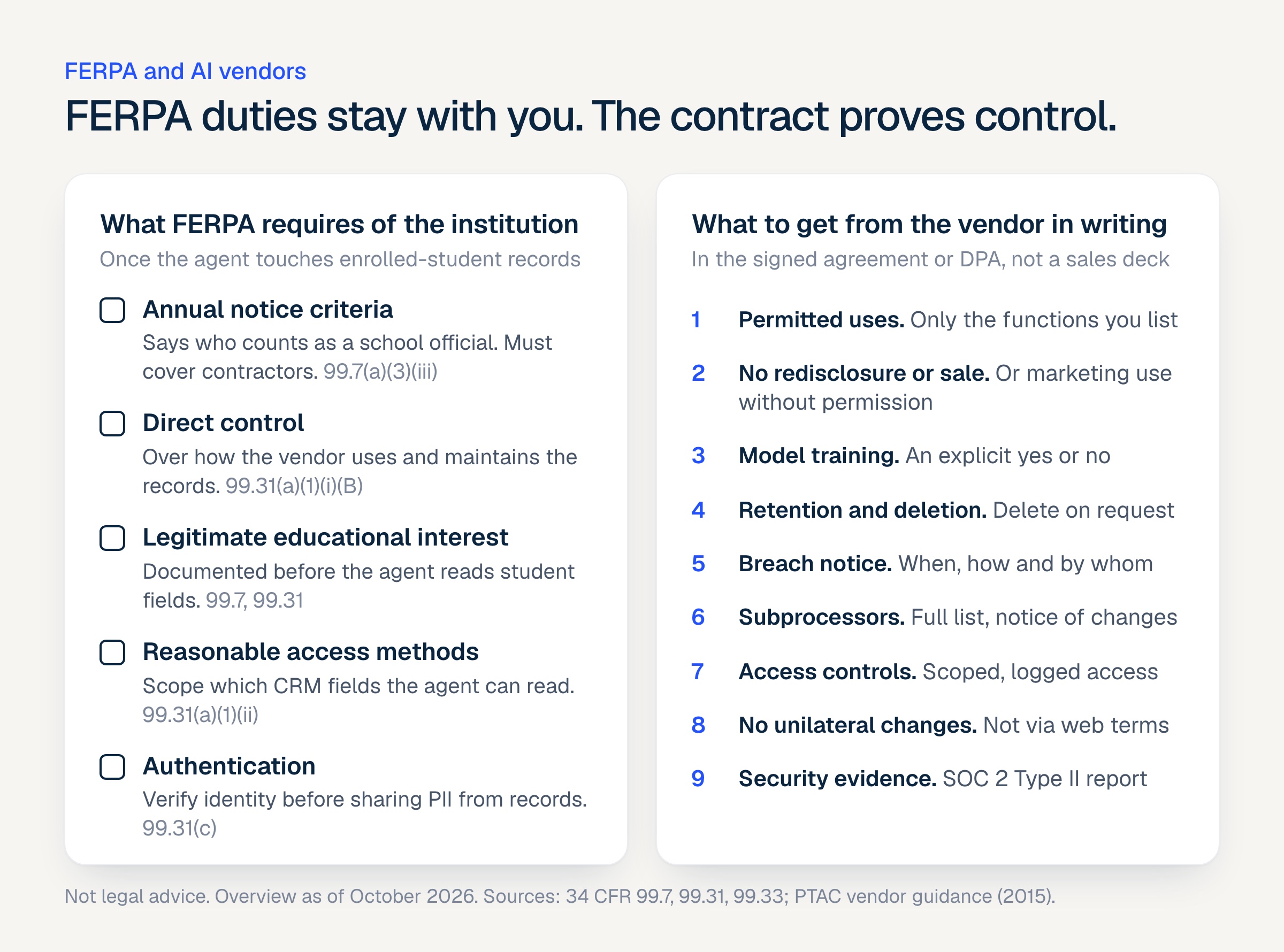
Once a student is in attendance, FERPA generally requires consent before you disclose personally identifiable information from education records. The exception that covers most vendors is the school official exception at 34 CFR 99.31(a)(1)(i)(B). An outside party to whom you've outsourced a function "may be considered a school official" if it:
"Performs an institutional service or function for which the agency or institution would otherwise use employees." Answering student questions and following up by text and phone is work your staff would otherwise do, so an AI agent usually fits.
"Is under the direct control of the agency or institution with respect to the use and maintenance of education records."
Is subject to 34 CFR 99.33(a), which says the recipient may use the information "only for the purposes for which the disclosure was made" and may not redisclose it without consent.
Two institutional duties come with it. Your annual FERPA notice must specify "criteria for determining who constitutes a school official" and "what constitutes a legitimate educational interest" (34 CFR 99.7(a)(3)(iii)). If that notice doesn't cover contractors, fix it before the agent touches enrolled-student data. And under 99.31(a)(1)(ii), you must use "reasonable methods" so school officials, vendors included, get access only to records they have a legitimate educational interest in. For an AI agent, that means scoping which CRM fields it can read, not handing it the whole student record.
Authentication matters when the agent talks to enrolled students
34 CFR 99.31(c) requires institutions to "use reasonable methods to identify and authenticate the identity" of anyone receiving PII from education records. A text from a known phone number isn't strong authentication on its own. Phones get shared and numbers get recycled. If your agent will discuss grades, balances or enrollment status with enrolled students, decide how it verifies identity first, or keep those topics behind a portal login or a warm transfer to staff. The guide to warm transfers to admissions advisors covers where that handoff should happen.
Can an AI vendor be "FERPA compliant"?
FERPA applies to educational agencies and institutions that receive Department of Education funds. It has no audit, seal or certification program. When a vendor says "we're FERPA compliant," the useful follow-up is "what will you sign that lets us show direct control?"
The Department's Privacy Technical Assistance Center (PTAC) answered that in its guidance for vendors, Responsibilities of Third-Party Service Providers under FERPA. It says "FERPA still governs" use of education records disclosed to a provider, "and the school or district is responsible for its protection." It also names contract changes as a direct-control problem. Changing terms of service "without notice or documentation makes it difficult" for a school to demonstrate direct control. A vendor that can rewrite its data terms by updating a web page weakens your FERPA position.
SOC 2 Type II reports, encryption and penetration tests are real evidence about security. They don't settle FERPA, because FERPA is about who may use the data and for what. You need both: a security report that shows the controls work, and a contract that limits use.
What should the AI vendor contract or DPA include?
PTAC's vendor guidance and the regulations above point to the same set of terms. Get them in the signed agreement or data processing agreement, not just in a sales deck or a security questionnaire. Ask every vendor on your shortlist, Apten included, for each of these in writing.
Permitted uses. List the functions the vendor performs for you, and limit use of student data to those functions. PTAC says provider use of PII "should be limited to only those purposes specified in the contract or agreement."
No redisclosure or sale. The vendor may not share or sell PII, or use it for marketing, without your written permission. PTAC warns that sharing or selling PII to other parties for marketing "may also violate Federal or state law."
Model training. Say whether the vendor or its AI providers may train or fine-tune models on your conversations. If the answer is no, say so. If it's yes for de-identified data, define de-identification and ban re-identification. PTAC recommends both.
Retention and deletion. Set how long conversation logs, call recordings and transcripts are kept. Require deletion on request and at contract end, with a timeline and method. PTAC calls a certificate of destruction a best practice.
Breach notification. Define when the vendor must notify you, how and by whom, and what the notice must include.
Subprocessors. AI agents depend on other companies for language models, speech-to-text, telephony and hosting. Get the list, the data each one receives, and advance notice before it changes.
Access controls. Which vendor staff can see student conversations, how access is logged, and which CRM fields the agent can read. This is how you meet the "reasonable methods" standard in 99.31(a)(1)(ii).
No unilateral changes. Data-use terms can't change by updating online terms of service. Changes require notice and your agreement.
Security evidence. A current SOC 2 Type II report or equivalent, with the right to review it each year.
For the full vendor question list, including CRM integration, guardrails and pricing, see the AI enrollment agent RFP questions.
Is texting applicants a FERPA issue, and what laws do apply?
Texting an inquiry or applicant who has never attended is usually not a FERPA issue. That doesn't make it unregulated. The rules that apply to prospects are mostly telecom and consumer-protection law:
TCPA. Automated texts and calls need the right consent, and in February 2024 the FCC ruled that AI-generated voices count as "artificial or prerecorded voice" under the TCPA. That brings AI voice calls under the same consent rules as robocalls. The AI compliance guide for TCPA, FCC and state laws covers consent, quiet hours and opt-outs.
Carrier registration. Admissions texting from a 10-digit number needs A2P 10DLC brand and campaign registration. See 10DLC registration for colleges and universities.
State privacy laws. Coverage depends on what kind of institution you are. The California AG says the CCPA applies to for-profit businesses that meet its thresholds and "generally does not apply to nonprofit organizations or government agencies." A for-profit career college and a public online university can land in different places, so map this with counsel.
GLBA, if financial aid data is involved. Federal Student Aid's GENERAL-23-09 announcement says information obtained by providing a financial service to a student, including administering Title IV aid, is customer information under the GLBA Safeguards Rule. The amended rule took effect June 9, 2023, and requires institutions to oversee their service providers. If your agent discusses aid packages or loan status, that data is in scope.
Bot-disclosure laws. California's SB 1001, in effect since July 1, 2019, bars using an undisclosed bot to knowingly deceive someone in order to incentivize a sale, and a clear disclosure that it's a bot satisfies it. Utah's AI Policy Act, narrowed by SB 226 in 2025, requires disclosure when a consumer clearly asks whether they're talking to AI. Disclosing up front is the simplest way to stay inside both.
A practical FERPA checklist for AI admissions agents
Before you launch, or before your next vendor renewal:
Map who the agent talks to. Split prospects and applicants from enrolled students, current students applying elsewhere at your institution, and stop-outs. Use the table above as a starting point.
Scope the data. For prospect-only use, keep enrolled-student fields like grades, balances and holds out of the agent's reach. If you need them, document the legitimate educational interest.
Check your annual FERPA notice. Confirm its school official criteria cover contractors and AI vendors.
Decide on authentication. Pick which topics the agent can discuss with enrolled students, and how it verifies identity first.
Get the contract terms in writing. Use the nine terms above. Don't accept "we're FERPA compliant" as a substitute.
Cover the non-FERPA rules. Consent capture, DNC scrubbing, 10DLC registration, quiet hours, AI disclosure and GLBA scope if aid comes up.
Review conversation logs. Spot-check transcripts each month for enrolled-student data showing up where it shouldn't.
How Apten fits a FERPA review
Apten is a multichannel AI enrollment agent. One agent texts, calls, emails and chats with each student, with one memory across channels. Most of that work happens before enrollment, with inquiries and applicants, where FERPA generally doesn't apply. If you use an agent with enrolled students or stop-outs, the contract terms above are where the FERPA work happens.
Apten has completed a SOC 2 Type II audit, and data is encrypted at rest and in transit. Guardrails you define are checked before any message sends, so you can keep the agent off topics like grades or account balances and route those questions to a person with a warm transfer. The agent catches opt-outs from STOP keywords and from plainly worded requests like "please stop texting me," tracks them per channel, and can sync them back to your systems by webhook. Quiet hours are configurable and apply in the student's time zone when it's known.
Your counsel should review the signed terms, not a summary on a blog. Bring the contract list above to the conversation.
The bottom line
FERPA doesn't follow a prospective student around. It starts when they're in attendance, and it covers the records you keep from then on, including the file from when they applied. For the prospect stage, your real exposure is the TCPA, carrier rules, state privacy and bot-disclosure laws. Once students enroll or you start re-enrolling stop-outs, treat your AI vendor as a school official and make the contract prove you have direct control.
Book a 20-minute demo and bring your security and FERPA questions, or learn more at apten.ai.
Sources
34 CFR 99.3, FERPA definitions of attendance, education records and student
34 CFR 99.31, conditions for disclosure without consent, including the school official exception
34 CFR 99.33, limits on redisclosure, 34 CFR 99.5 and 34 CFR 99.7
Future of Privacy Forum, Who Exactly IS a "School Official" Anyway?
FCC, Declaratory Ruling on AI-Generated Voices Under the TCPA, FCC 24-17 (February 2024)
California Attorney General, California Consumer Privacy Act
Loeb & Loeb, New California Regulations Mandate Disclosure of Bots (SB 1001) and Future of Privacy Forum, Chatbots in Check: Utah's Latest AI Legislation