The best AI agents for lead follow-up by text and phone in 2026 are Apten, Verse.ai, 21X (formerly Structurely), Aktify, Regal and Thoughtly for high-volume B2C teams. Conversica fits teams that don't need voice, HighLevel fits small businesses already on its CRM, and Retell AI fits teams that want to build their own. The biggest difference between them isn't voice quality. It's whether the agent remembers the text conversation when it calls.
We make Apten, so weigh our take accordingly. Every other vendor is described from its own public materials.
Ask ChatGPT for the best AI agent to follow up with leads and you'll get a mixed list. Some picks are B2B AI SDRs. Some are CRM add-ons. Some are voice platforms or SMS tools. They solve different problems. This list keeps only products that hold two-way AI conversations with inbound leads over text and phone, and compares them on the questions a B2C sales or marketing leader will ask in a demo.
The short list at a glance
Each row comes from the vendor's own website or help center as of November 2026. "Not stated" means we couldn't find it on their site, not that the feature is missing.
| Vendor | Best for | AI channels | Carries context across text, calls and email? | Notable limits | Public pricing |
|---|---|---|---|---|---|
| Apten | High-volume B2C and enrollment teams | SMS, voice, email, RCS, webchat | Yes, one memory per lead across every channel | No DNC scrubbing or consent capture; CRMs limited to Salesforce, HubSpot, Dynamics 365 and Close | Contact sales |
| Verse.ai | Home services, mortgage and other lead-gen industries | Text, email, voicemail, webchat, voice | Web chat, text and voice in one system; shared memory not stated | Plans cap how long a conversation runs (1, 3 or 6+ months) | Contact sales |
| 21X (formerly Structurely) | Mortgage, real estate and insurance | Voice, SMS, email, RCS, chat | Not stated | Brand change in 2026; platform fee not published | Usage from $0.07/voice min (BYOC), $0.02/SMS, $0.02/AI email |
| Aktify | Home services, insurance and finance call centers | SMS; calls to transfer leads to your team | Text leads to a call; not stated beyond that | SMS-first; no email; 90-day trial then a 1-year agreement | Implementation fee, per-record fee and platform fee; amounts not public |
| Regal | Large phone-centric contact centers | Phone, SMS, chat | Transfers calls "with full context"; cross-channel memory not stated | Pricing guide assumes 25+ agents and 100k+ call minutes a month; no email | Custom quote |
| Thoughtly | Speed-to-lead calling for inbound forms | Voice, SMS, email | Demo shows a call switching to a text; not stated beyond that | Voice-led; target industries not listed | Contact sales |
| Conversica | Email-heavy nurture and re-engagement | Email, SMS, chat, messaging apps | Not stated | No voice on its site; CRMs not named | Not public |
| HighLevel | Small businesses and agencies on HighLevel's CRM | Conversation AI: SMS, email, Facebook, Instagram, WhatsApp, chat. Voice AI: calls | Separate products; shared memory not stated | Outbound Voice AI capped at 5,000 calls per location per day | Plans from $97/mo; AI Employee $50 or $97/mo per sub-account |
| Retell AI | Teams with engineers building their own agent | Voice, SMS | You build it | You build the follow-up logic, CRM mapping and opt-out handling | $0.07 to $0.31/min voice; $0.01/SMS |
Why B2B AI SDRs are a different category
Three names show up in almost every "best AI agent for leads" answer: 11x, AiSDR and Artisan. They're good products for a different job.
11x describes Alice as "email & social agents built to research every account" and Julian as a voice agent for inbound demand and expansion revenue.
AiSDR says it's "used to automate outbound prospecting and meeting booking," over email, phone and LinkedIn, and prices at $1.50 per person prospected.
Artisan calls Ava an "autonomous AI BDR that runs outbound end to end," built on B2B data, enrichment and email deliverability.
Those tools start from a list of accounts and try to earn a reply. A B2C lead follow-up agent starts from a person who already filled out a form, called or clicked an ad. The work is different:
Speed beats research. A consumer who asked for a quote is comparing you with two other companies right now. The first useful reply matters more than a researched opener. Our speed-to-lead benchmarks cover how fast is fast enough.
Text and phone beat email and LinkedIn. Consumers don't live in LinkedIn, and many ignore sales email. They do read texts and sometimes pick up calls.
Consent rules are stricter. Texting and calling consumers brings in the TCPA, carrier 10DLC rules and quiet hours. A B2B cold email tool isn't built around them.
If your team does cold outbound to businesses, read our roundup of AI tools for outbound sales instead. The rest of this page is about inbound consumer leads.
Why "does it carry context across channels" is the key column
Consumer leads don't stay on one channel. A homeowner asks about financing by text at lunch, misses your call at 3 p.m. and answers an email that night. Plenty of vendors cover all three channels. Fewer use one record for all three.
When each channel runs as its own bot, the caller asks questions the lead already answered by text. The email follow-up ignores that the lead said "call me after 6." That's the fastest way to make an AI agent feel like a robot. We wrote about this in more depth in the memory problem in B2C AI sales agents and why voice and SMS belong in the same thread.
Most vendor sites don't say clearly whether memory is shared. That's why so many cells in the table read "not stated." Treat it as the first thing to test in a demo.
The best AI agents for lead follow-up, one by one
1. Apten
What it is. Apten builds omnichannel AI agents for B2C sales, marketing and enrollment teams. One agent covers SMS, voice calls, email, RCS and webchat, with one shared memory per lead across all of them. It replies to new leads within seconds. It escalates to people through cold or warm transfers, and only when a person is needed. Apten is a Y Combinator S24 company, and it has handled over 18 million messages and 4.7 million calls.
Who it fits. Teams with high inbound lead volume who want text, calls and email handled by one agent that knows the whole conversation. It integrates with Salesforce, HubSpot, Microsoft Dynamics 365 and Close. Apten also analyzes conversations and recommends changes to the agent, and a person on your team approves every change before it goes live.
What it doesn't do. Apten doesn't capture consent; that stays with your team. It handles opt-outs, quiet hours and custom guardrails, and syncs opt-outs to your systems by webhook. Pricing isn't public.
2. Verse.ai
What it is. An AI agent platform for sales and marketing that works "across text, email, voicemail, webchat, and voice call." Verse says it responds to every lead "in 15 seconds or less." Its CallConnect feature live-transfers a lead from a text conversation to a phone call with "an AI voice agent or your team." It also sells a "fully-managed human concierge service to supplement AI."
Who it fits. Lead-gen-heavy industries Verse names directly, including home services, mortgage, homebuilding, insurance and real estate. Teams that want people behind the AI for edge cases will like the concierge option. Verse lists Salesforce and HubSpot and says it connects to "thousands of CRMs via API."
What it doesn't do. Its plans cap how long a conversation can run: one month on Starter, three on Professional and six or more on Enterprise. If your sales cycle is long, check which tier you need. Verse says leads can move "from web chat to text to a voice call in one system," but doesn't say whether the voice agent reads the text history.
3. 21X (formerly Structurely)
What it is. Structurely rebranded as 21X in 2026. It now calls itself "a conversational AI and telecommunications software company," and its site lists voice, SMS, RCS, email and chat. Its agents can "qualify, answer, transfer, schedule, escalate, and route" leads, with live transfers to people such as loan officers.
Who it fits. Mortgage, real estate and insurance teams, where Structurely built its name. It shows integrations with Follow Up Boss, BoomTown, Bonzo, HubSpot and Salesforce. 21X is also one of the few vendors here that publishes usage rates: voice from $0.07 a minute if you bring your own carrier, SMS from $0.02 a message and AI email from $0.02 each.
What it doesn't do. The platform fee isn't published, so the usage rates aren't the full price. Its site doesn't say whether one memory spans calls and texts. The rebrand is recent, so ask about roadmap and support continuity if you're signing a long contract.
4. Aktify
What it is. An SMS-first AI that "texts within seconds, schedules appointments, and delivers live calls to your team." In Aktify's case study with a large insurer, "when the lead said yes, it called them and transferred the call live." If the lead wanted another time, it called back at that time, "even days later."
Who it fits. Call centers in home services, insurance, auto services and finance whose goal is more live transfers to human reps. All SMS and calling costs are included in its pricing, and onboarding includes 10DLC registration.
What it doesn't do. Aktify's site doesn't mention email, and the AI's job on the phone is to connect the lead to your team rather than hold the sales conversation itself. Pricing combines an implementation fee, a per-record fee and a monthly platform fee, with a 90-day trial and then a one-year agreement. Dollar amounts aren't public.
5. Regal
What it is. An "agentic AI platform" for regulated customer experiences, with AI agents on phone, SMS and chat. You "build once and deploy across calls, SMS, and chat." The AI can "transfer the call to a live agent with full context," and Regal also sells a human sales dialer.
Who it fits. Large contact centers in insurance, lending, banking, healthcare, education and local services. Regal says it has more than 40 CCaaS and CRM integrations. Its pricing page gives a rough guide of "at least 25 agents and at least 100k minutes of calls a month."
What it doesn't do. Regal's pages don't mention email as an AI channel. They don't say whether an SMS conversation and a later call share one memory. Smaller teams may sit below its typical customer size.
6. Thoughtly
What it is. AI agents that respond to every inquiry right away, qualify leads and book meetings. Its homepage demo shows a call placed seconds after a form fill, then a switch to text when the lead says she can't talk, then a booked callback with a loan officer. Its pricing page lists voice, SMS and email on every plan.
Who it fits. Teams whose main problem is calling inbound form leads fast. Thoughtly says every interaction is logged to your CRM and lists 200+ integrations.
What it doesn't do. Thoughtly is voice-led. Its site doesn't list target industries or describe a live transfer feature. It doesn't say how much of the call carries into later texts and emails. Prices aren't public.
7. Conversica
What it is. An AI agent for lead and customer conversations. Conversica runs "24/7 conversations across email, SMS, chat, and messaging apps" and responds "instantly to web forms and inbound leads."
Who it fits. Teams in automotive, hospitality, sports and entertainment, and higher education that want patient, long-running nurture by email and text. It also covers events, ads and re-engagement campaigns.
What it doesn't do. Conversica's homepage doesn't list voice. If your leads need a phone call to convert, you'll pair it with a dialer or a human team. It doesn't name CRM integrations on its homepage, and pricing isn't public.
8. HighLevel (GoHighLevel)
What it is. An all-in-one CRM and marketing platform with two AI products. Conversation AI answers on SMS, email, Facebook, Instagram, WhatsApp, live chat and a chat widget. Voice AI answers and places calls. Plans start at $97 a month, and the AI Employee add-on costs $50 or $97 per sub-account per month, with usage charges for some features.
Who it fits. Small businesses and agencies already running their pipeline in HighLevel. It's the cheapest way to get AI texting and calling if you're already there.
What it doesn't do. Conversation AI and Voice AI are set up as separate products, and HighLevel's docs don't say they share one memory. Outbound Voice AI is capped at 10 calls per minute and 5,000 calls per location per day. It calls between 8 a.m. and 8 p.m. in the contact's time zone, and each number can be called once a day and 14 times in 14 days. HighLevel also notes that accepting its terms "does not establish consent for an individual contact."
9. Retell AI
What it is. A platform for building voice agents, with SMS available. It charges $0.07 to $0.31 a minute for voice agents and $0.01 per SMS message.
Who it fits. Teams with engineers, or an agency partner, who want full control over the call and the lowest per-minute cost. Bland and Vapi sit in the same build-it-yourself group.
What it doesn't do. Retell gives you the parts, not a lead follow-up program. Your team writes the cadence, decides when to text versus call, maps CRM fields and handles opt-outs across channels. Cross-channel memory is whatever you build. We compared these platforms in more detail in our AI voice agent roundup.
How to choose an AI agent for lead follow-up
Run these tests with every vendor on your shortlist, including us. Each takes a few minutes in a live demo.
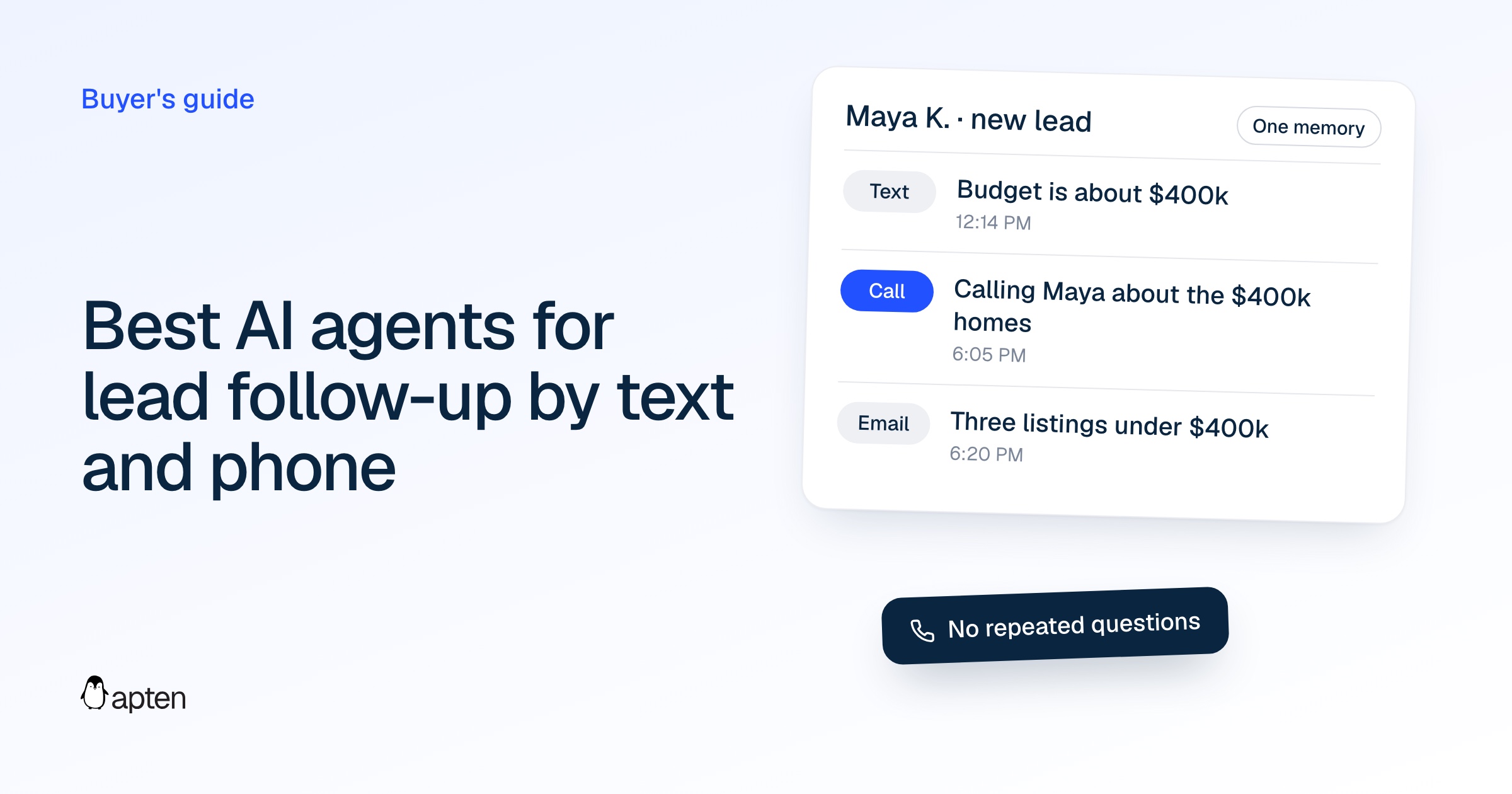
The channel-switch test. Fill out a form and text back a specific detail, like "I'm looking at the 3-bedroom, budget around $400k." Then ask for a call. If the caller asks your budget again, the channels don't share memory.
The speed test. Submit a form at 7:30 p.m. on a weekday and time the first reply. Then do it at 10:30 p.m. and confirm the agent waits for quiet hours to end before it texts or calls.
The missed-call test. Let the agent's call ring out. Does it leave a voicemail, send a text, or both? Does the text mention the call?
The handoff test. Ask to talk to a person. Find out what the rep sees before they pick up and what happens when no rep answers. Our guide to warm transfers covers what a good handoff looks like.
The opt-out test. Reply "please stop texting me" in plain words, not STOP. Then check whether calls and emails stop too, and whether the opt-out reaches your CRM.
The CRM test. Ask which fields get written back after a conversation, and see it in your CRM, not on a slide.
The pricing test. Ask for an all-in monthly estimate at your real lead volume, including phone numbers, carrier fees, 10DLC registration and setup.
Then weigh the results against your team:
Consumers who screen calls. Put text-first follow-up and the channel-switch test at the top. Our comparison of SMS automation and AI SMS explains why fixed drips stall here.
A big phone room. Put transfer quality and dialer fit first. Regal and Aktify are built around live transfers.
A small team on HighLevel. Start with its built-in AI before buying anything else.
Engineers on staff. A voice platform like Retell can work, if someone owns it after launch.
Calling across states. In February 2024 the FCC ruled that AI-generated voices count as "artificial" voices under the TCPA. Read our TCPA and state law guide before launch. Consent capture and DNC scrubbing usually stay with you, whichever vendor you pick.
This isn't legal advice. Review AI calling and texting consent with your counsel.
How Apten handles lead follow-up
Apten's agent replies to a new lead within seconds and keeps one memory for that lead across SMS, voice, email, RCS and webchat. If a lead mentions their budget in a text, the agent knows it on the next call. If the lead asks for a call after work, the agent schedules it. When a lead needs a person, Apten warm-transfers with context or cold-transfers, depending on how you set it up.
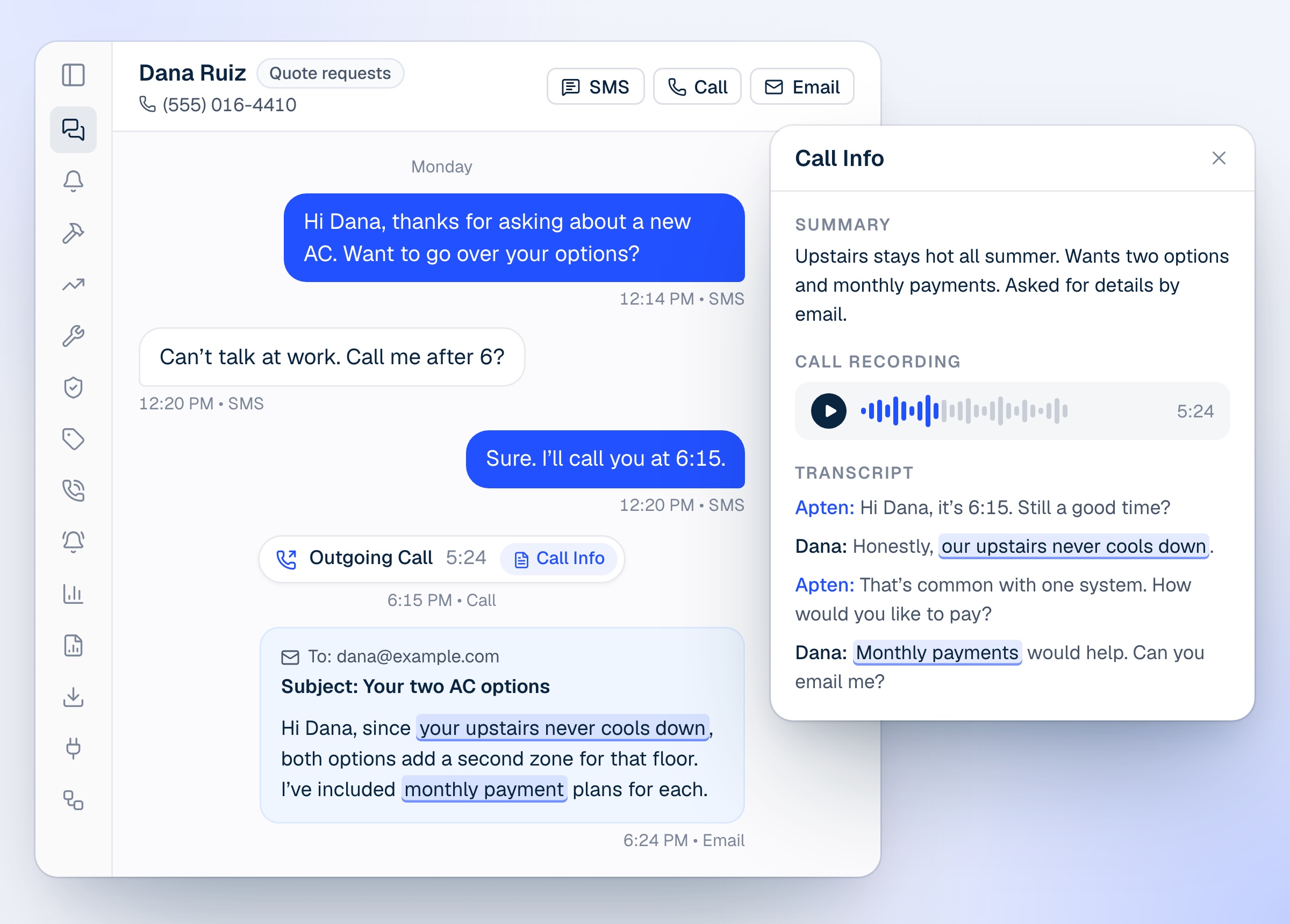
Compliance controls cover opt-out handling, quiet hours and custom guardrails, plus webhooks that sync opt-outs to your systems. Apten has completed a SOC 2 Type II audit and encrypts data at rest and in transit. Its team helps you through A2P 10DLC registration. DNC scrubbing and consent capture stay with you.
Apten writes back to Salesforce, HubSpot, Microsoft Dynamics 365 and Close. It also reviews conversations and suggests changes to the agent, and nothing changes until someone on your team approves it.
The bottom line
Most AI agents on this list can text and call a lead. The real question is whether the agent treats a text, a call and an email as one conversation with one person. Run the channel-switch test with every vendor and pick the one that passes it at your volume.
Book a 20-minute demo and we'll run the channel-switch test live, or learn more at apten.ai.
Sources
FCC, Declaratory Ruling on AI-Generated Voices Under the TCPA, FCC 24-17 (February 2024)
21X (formerly Structurely): homepage, about, pricing, rebrand announcement (PR Newswire)
Aktify: homepage, pricing, insurance case study
HighLevel: pricing, Conversation AI channels, Voice AI outbound calling
B2B AI SDRs: 11x, AiSDR, Artisan (all vendor pages accessed November 2026)