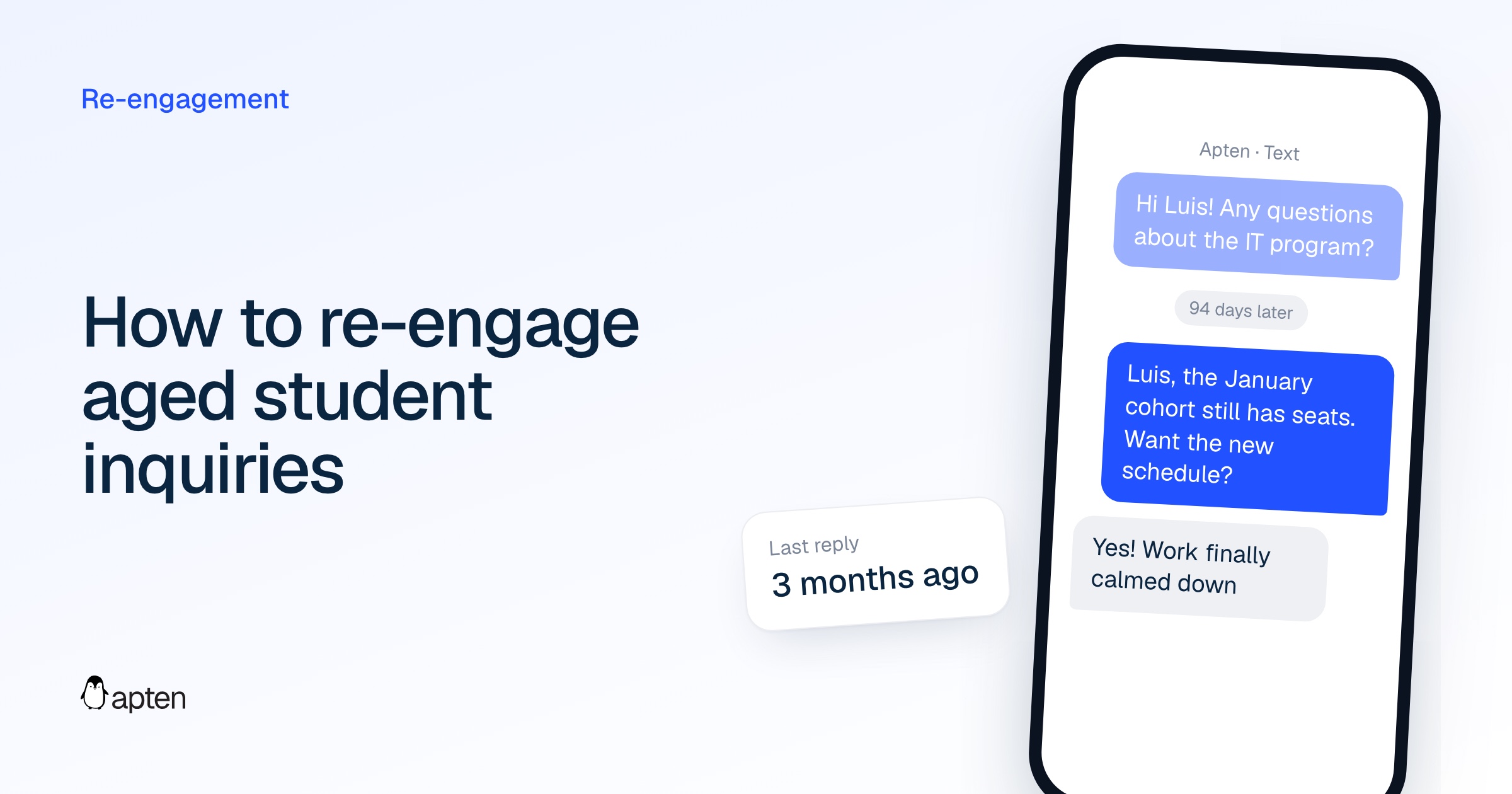
To re-engage aged student inquiries, split your database by how long each lead has been quiet and where it stalled (never contacted, contacted but no application, application started, admitted but not started, or stopped out), then give each segment its own message, channel order and stop rule. Expect far lower reply rates than new inquiries get. In Apten's data, students who had gone quiet for three weeks or more replied to follow-up at a median 8.4% one to three months after they entered, and 5.2% at three to twelve months.
Most enrollment teams have more aged inquiries than they think, and a lot of them were never really worked. In UPCEA's December 2025 secret shopper study, 44% of 1,000 inquiries to 182 institutions got no response at all. Among RFIs that included a phone number, only 24% logged a call from the institution in the first 30 days, and 29% got a text. If your team looks anything like that, a chunk of your "aged" list is students nobody ever talked to. The same problem shows up earlier in the funnel, as covered in why college inquiries go unanswered.
Then there are the stop-outs. The National Student Clearinghouse counts 37.6 million working-age adults with some college and no credential. More than one million of them re-enrolled in 2023-24. Most went somewhere new, since only 36.1% of re-enrollees returned to the institution they left. Primarily online institutions were the last school for about 5% of the stop-out population but took roughly 15% of re-enrollments. For online programs, adults coming back to school are a real market, and the school that stays in touch has the edge.
This guide is the higher-ed version of our general lead revival playbook. It covers how to segment, what to say, which channels to use, how often, when to stop, how to keep consent clean, and how to measure it.
What counts as an aged inquiry, a closed-lost lead and a stop-out?
These three groups get lumped together, but they want different things from you. Mixing them in one campaign is the most common reason re-engagement flops.
| Group | Who they are | What they already know | What usually stopped them |
|---|---|---|---|
| Aged inquiry | Submitted an RFI, never applied | Your name and maybe one program | No timely reply, life got busy, still comparing schools |
| Closed-lost lead | Marked lost in the CRM after talking to an advisor, starting an application or getting admitted | Tuition, requirements, their advisor | Cost, timing, a missing checklist item, a competitor |
| Stop-out | Enrolled, earned some credits, left without a credential | Your courses, your LMS, maybe their old advisor | Work, family, money, a bad term |
Stop-outs are a different kind of record. Their data comes from your student information system, not the admissions CRM, and records from their time enrolled are FERPA education records. Ask your registrar and counsel what can go into an outreach tool before you load it anywhere. Our post on FERPA and AI agents covers where that line falls.
How should you segment old student leads?
Use two axes: time since last contact and furthest funnel stage. Age tells you how much the student remembers. Stage tells you what they need to hear.
Age buckets that work well are 30 to 90 days, 90 to 180 days, 180 to 365 days, and over a year. Under 30 days isn't aged yet. Those students belong in your normal follow-up cadence. Over a year, the student's situation has probably changed, and so has the quality of your contact data and consent.
For stage, use the milestones your CRM already tracks: RFI, contacted, app started, app submitted, admitted, enrolled. Then cross the two.
| Segment | Priority | Opening angle | First channel | Max touches |
|---|---|---|---|---|
| Never contacted, 30 to 180 days | Highest | Apologize briefly, answer the original question, offer a next step | Text, then email | 4 over 3 weeks |
| Contacted, no application | High | Next start date and one concrete reason to apply now | Text | 3 over 3 weeks |
| Application started, not submitted | High | What's left to finish, offer help from an advisor | Text, then call if they reply | 3 over 2 weeks |
| Admitted, didn't start | Medium | The next term, whether the admission still stands | Email, then text | 3 over 4 weeks |
| Stop-out, recent (1 to 2 years) | Medium | Credits they already have, how to come back | Email, then text | 3 over 6 weeks |
| Anything over a year with old or vendor consent | Review first | Confirm consent before any text or call | Email only until reviewed | 1 or 2 |
The touch counts are starting points, not rules. Change them once your own reply and opt-out data comes in.
What should you say to each segment?
The first message decides whether the student replies. Three rules cover most of it.
Name the program they asked about. "Still thinking about the RN to BSN?" gets more replies than "We'd love to help you reach your goals." It also proves the message isn't spam.
Ask a question that's easy to answer. Yes or no, or a choice between two start dates. A student who hasn't thought about you in four months won't write a paragraph.
Don't pretend no time has passed. If the student never heard back, say so. "Sorry we dropped the ball on your question about transfer credits" is honest, and it usually lands better than a cheerful script.
Some examples by segment:
Never contacted. "Hi Dana, this is the admissions team at [School]. You asked about our online MBA back in June and we never got back to you. Sorry about that. Are you still looking at programs for spring?"
App started. "Hi Marcus, your application for the cybersecurity certificate is mostly done. Want me to tell you exactly what's left, or set up 10 minutes with an advisor?"
Admitted, didn't start. An email that confirms the admission is still valid for the next term, lists the start date, and links to a calendar to talk it through.
Stop-out. "You finished 42 credits with us. Here's what it would take to finish your degree, and how our current transfer and re-entry options work." Lead with the credits. That's the asset they forgot they had.
Skip discount-first messages unless you actually have one. A fake deadline will burn a list faster than silence.
Which channels and cadence work for re-engagement?
Text gets seen. Email gets read. Calls convert. Use them in that order for most segments.
A short text is the best way to find out whether the number still works and whether the student still cares. Adult learners often prefer email for anything with detail, such as tuition, transfer credits or financial aid, so follow the text with an email that has the specifics. Save the phone call for students who reply or ask for one. A call from an unfamiliar number months after the inquiry is easy to ignore, and AI or autodialed calls carry the same consent requirements as texts, so shaky consent hurts you on both.
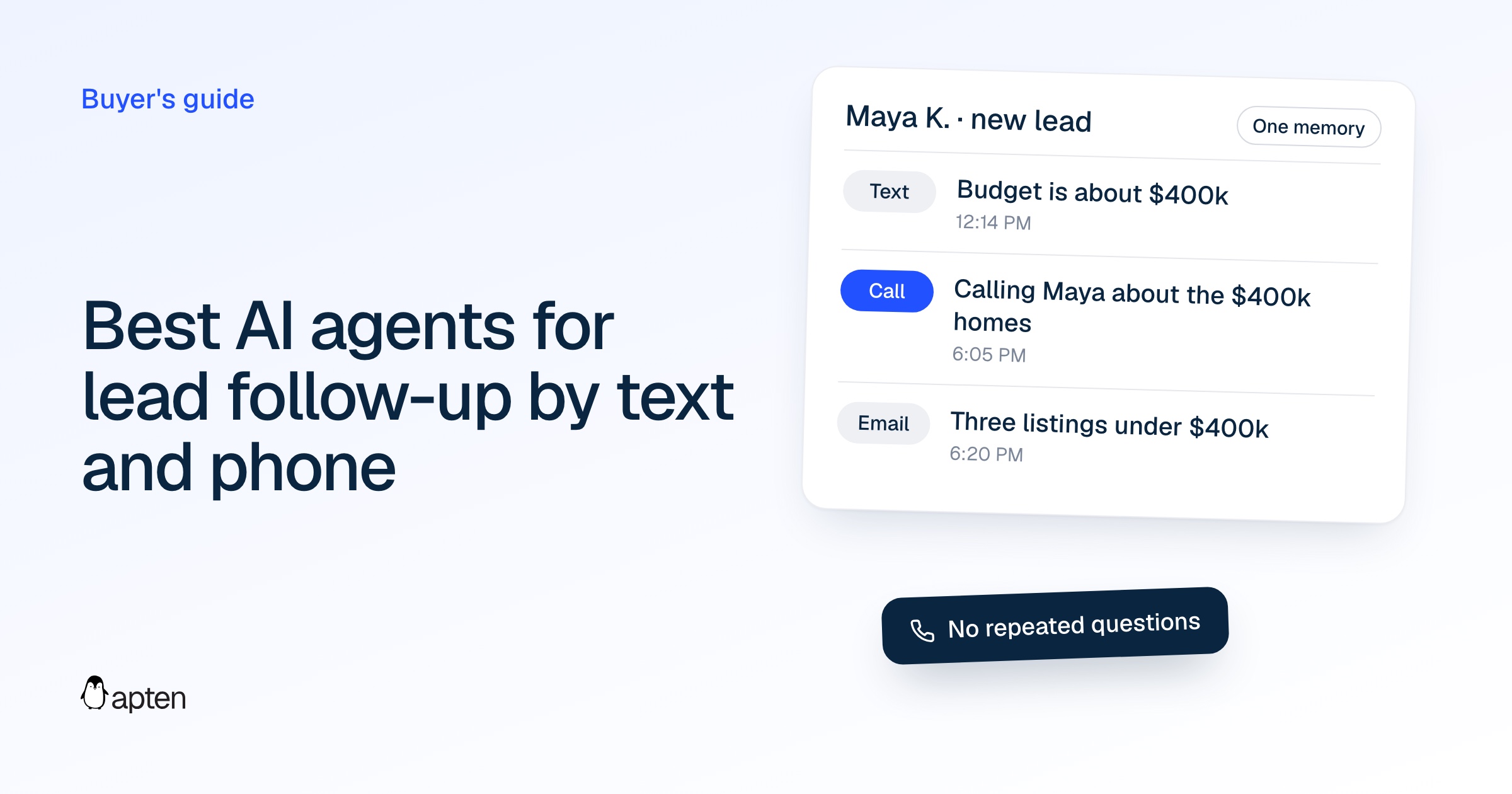
The part that matters most is memory across channels. If a student replies to the text, ignores the email and then calls the main line, the person or agent who answers should know about the text. A re-engaged student who has to explain themselves again is likely to drop off a second time.
For cadence, a reasonable default for a warm segment looks like this:
Day 1: text, during the student's local daytime hours.
Day 3: email with program details and a booking link.
Day 8: second text with a different angle, such as a start date or an info session.
Day 15 to 21: final text that makes it easy to say no ("Should I close out your file?").
A direct question about closing the file is easy to answer, even when the answer is "not now," and "not now" still tells you when to come back.
What reply rates should you expect from aged inquiries?
Lower than you're used to, and that's fine. Here is what Apten saw across education orgs between July 28 and October 25, 2026. One caveat on the definition: "age" here means time since the lead entered Apten, not the CRM create date, so a lead imported into Apten in August counts from August.
| Group | Schools | Median reply rate |
|---|---|---|
| New inquiries, first touch (almost always a text) | 11 | 56% |
| Silent 3+ weeks, entered 1 to 3 months earlier | 13 | 8.4% |
| Silent 3+ weeks, entered 3 to 12 months earlier | 12 | 5.2% |
A reply is any inbound text, email or call from the student, or an answered outbound call, within 7 days of the follow-up. Opt-outs stayed under 0.5% in both aged groups.
Two things stand out. First, the drop from a new inquiry to a quiet one is steep. That's the strongest argument for working every RFI in the first minutes instead of saving it for a re-engagement campaign later. Second, opt-outs on these follow-ups stayed under half a percent. Students who once asked you for information rarely object to one polite follow-up. The risk sits in cold lists, old vendor leads and badly timed blasts.
A 5% reply rate sounds small until you do the math. As an illustration, 5% of a 20,000-name aged list is about 1,000 students back in conversation, with no new lead spend.
When should you stop contacting an aged lead?
Write the stop rules before the first send. They protect your sender reputation and your relationship with the student.
Opt-out on any channel. Stop that channel at once and decide whether to stop all of them. As of October 2026, the FCC's "revoke-all" rule, under which one revocation covers all of a sender's robocalls and robotexts, is scheduled to take effect January 31, 2027, after being delayed twice. Planning for it now is easier than retrofitting later.
"I enrolled somewhere else." Thank them, close the record, and tag the competitor if they name one. That's useful data.
No reply after the full cadence. Move them to a check-in once per start term at most, by email.
Bad data. Undeliverable numbers, bounced emails and landlines come out of the text sequence right away.
How do you keep student re-engagement TCPA-compliant?
Re-engagement is where consent problems show up, because the consent is old. Under the TCPA, marketing texts and calls made with an autodialer, or with a prerecorded or AI-generated voice, generally need the student's prior express written consent. The institution is responsible for having that consent and being able to prove it, and so is Do Not Call scrubbing. That responsibility doesn't move to your texting or AI vendor.
Questions to answer before you text an aged list:
Where did the lead come from? Your own RFI form is one thing. A lead bought from a third-party aggregator two years ago deserves a much closer look.
Did the consent language cover texts and calls from your institution? Pull the form version the student actually submitted.
Has the student revoked consent anywhere? Since April 11, 2025 (still the rule as of October 2026), the FCC has required senders to honor revocation made by any reasonable means within 10 business days, not only replies of STOP. Check every channel and system, including the call center's notes.
Is the number still theirs? Numbers get reassigned. The older the lead, the more likely you're texting a stranger.
Are your texting numbers registered? Carriers filter unregistered application-to-person traffic. Our guide to 10DLC registration for colleges and universities walks through it.
Send during reasonable local hours in the student's time zone, and check state rules, since some states set tighter calling windows and frequency limits than federal law. The wider rules are in our AI compliance guide for TCPA, FCC and state laws. This isn't legal advice. Have counsel review any campaign that uses old or vendor-sourced consent.
How do you measure a re-engagement campaign?
Track it by segment, not as one blended number. A blended reply rate hides the segment that's dragging the campaign down.
Reply rate within 7 days, by age bucket and stage.
Opt-out rate, by segment. If one segment runs well above the rest, pause it and check the consent source.
Advisor conversations, meaning appointments booked or live transfers.
App starts and submits from re-engaged students, credited to the campaign in your CRM.
Starts, the number your leadership actually cares about, measured a full term later.
Hold back a small random slice of each segment that gets no outreach. Some aged leads would have come back anyway, and without a holdout you'll give the campaign credit for them.
How Apten handles aged inquiries and stop-outs
Apten is a multichannel AI enrollment agent for online programs and large enrollment teams. One agent texts, calls, emails and chats with each student, and it remembers the whole history across channels. A student who replies to a re-engagement text and calls back two days later talks to an agent that already knows what they asked.
You build the segments in your CRM, where the stage and status data lives. Apten picks them up through CSV import with scheduled send dates, or through automations that watch Salesforce or Microsoft Dynamics fields and start a follow-up when a record changes. We also connect with HubSpot and Close. Once a student replies, the agent answers program questions from material you approve, moves the student from a text to a live call, books time with an advisor on Google Calendar or sends your Calendly link, or warm-transfers to an advisor with a summary. Replies, tags, opt-outs and a conversation summary write back to your CRM fields.
Guardrails you define are checked before every message sends. Quiet hours apply in the student's time zone, and opt-outs are caught from STOP keywords and from plainly worded requests like "please stop texting me," tracked per channel and synced back by webhook. Apten has completed a SOC 2 Type II audit and encrypts data at rest and in transit, and our team helps schools through A2P 10DLC registration.
The bottom line
Your aged inquiries and stop-outs are students who already raised their hand once. Segment them by age and stage, send each segment a short, honest message about the program they wanted, stop when they say stop, and measure against a holdout. Expect single-digit reply rates, and check your consent before you send.
Book a 20-minute demo to see how Apten re-engages an aged inquiry list, or learn more at apten.ai.
Sources
National Student Clearinghouse Research Center, Some College, No Credential report series
UPCEA, Enrollment Process Review: Secret Shopper Analysis (December 2025)
Kelley Drye, FCC Sets Effective Date for TCPA "Reasonable" Consent Revocation Rules
Burr & Forman, The FCC Delays Effective Date of TCPA Revoke-All Rule Until January 31, 2027
FCC, Declaratory Ruling on AI-Generated Voices Under the TCPA, FCC 24-17 (February 2024)
Apten platform data, education orgs, Jul 28 to Oct 25 2026. Age is time since the lead entered Apten. Reply counted within 7 days of the follow-up.